

A life — and afterlife — in poetry
A life — and afterlife — in poetry For Christian Wiman, ‘dead on the table’ more than once, suffering is no longer the only authentic thing Max Larkin...
 Written by Eze Chidiebere
A life — and afterlife — in poetry
For Christian Wiman, ‘dead on the table’ more than once, suffering is no longer the only authentic thing
Max Larkin
Harvard Staff Writer
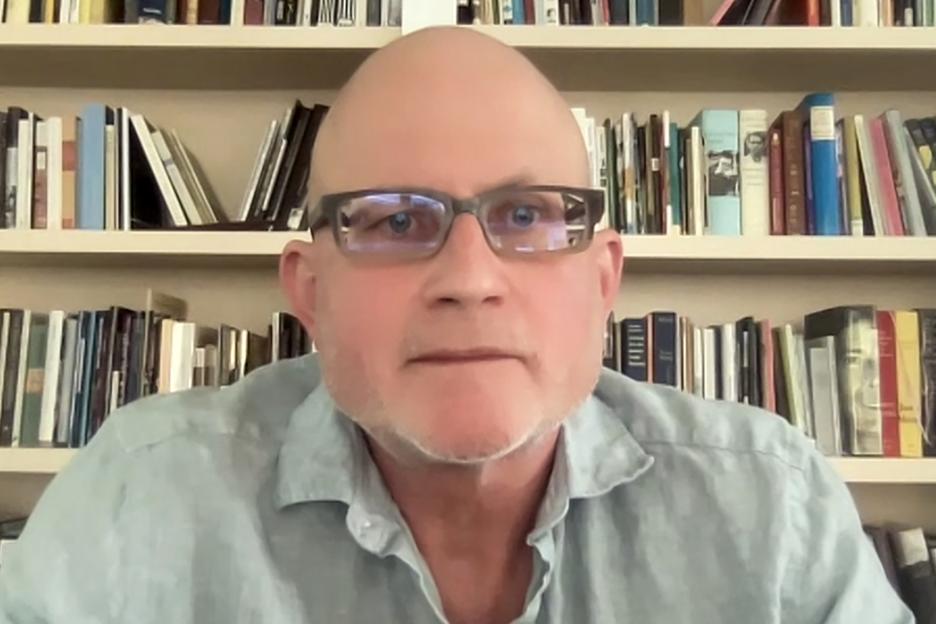
“I don’t give a lot of readings, to tell you the truth,” said Christian Wiman, at the end of one of those rare occasions. “I find them a bit difficult. I’ll probably go out and exercise a lot after this.”
It is not that Wiman has any qualms about a life in letters: He’s been poet, memoirist, teacher (now at Yale), and, for 10 years, the high-achieving editor of Poetry, the most prominent periodical of new verse in the U.S.
And if he’s not confessional, he’s not coy, either: Readers know about the rare blood cancer that was expected to kill him 14 years ago, and the spiritual searching of a onetime “ ambivalent atheist .”
The problem with readings may be that his chosen craft remains mysterious: subject to long droughts, punctuated by bursts of inspiration that seem inevitably to come from elsewhere.
For all that, Wiman reads well. It’s a tribute to his conception of poetry as, first and foremost, “structured sound,” with a note of the oracular: to preserve and share of the self, to channel the divine, and ideally both.
At a virtual event hosted by the Harvard Radcliffe Institute on Monday, ahead of the July publication of his seventh book of poems, “ The Dance ,” Wiman worried aloud about an era that threatens “the eradication of individual consciousness.”
After years of private and public searching, Wiman has come to understand faith as French philosopher Simone Weil did, essentially as a kind of attention that “we rarely, rarely have.” He sees God’s work in how the germ of a poem can come to him belatedly, prompted by an image or feeling that “I hadn’t even realized I’d noticed.”
Today, he argues, our attentions are “frazzled” and besieged; even his “ cancer chair ” came with a built-in TV. Our emotions run hot and our anxieties — ecological, political, personal, and economic — tend to multiply.
In one selection from the new book, Wiman quotes his friend and fellow poet Kevin Young in saying that — amid the “mosquito demons of email / and oil changes” — poems can be a “balm”:
… meaning,
in ancient days, a substance fragrant, resinous,
effective, for a time, against decay.
Wiman may be unusual, among his cohort, in a kind of conservatism on the page. His readings of six or so works show a durable fascination with rhyme and repetition, loanwords and double entendre: mist and missed, balm and embalm. One of his best-known poems, “ Every Riven Thing ,” contemplates the presence of God by tweaks to punctuation.
But he was a natural candidate for the Radcliffe’s Roosevelt Poetry Reading series , which has brought renowned poets in person and online to read and discuss their work. The event was moderated by Major Jackson, himself a prior Roosevelt reader and Wiman’s friend.
Jackson opened the discussion by asking about the “spiritual significance” of poetry.
At first Wiman, who has appointments at Yale Divinity School and its Institute of Sacred Music, seemed to search for an answer — but eventually he offered up Kay Ryan’s 2003 poem “ Tune ,” published in Poetry in the first year of his editorship.
It posits a music thrumming under everything, only sometimes audible: “How can something / so grand and serene / vanish again and again / without a hint?” “There is a tune of things,” Wiman said on reflection, “that I think is consciousness, and is God, and that somehow those things are linked … I haven’t quite gotten there, never quite gotten to the end.”
Wiman’s poems can be funny. “Five Doors Down” and “ I Don’t Want To Be A Spice Store ,” which he read Monday, draw on his West Texas childhood, the latter imagining his father after a “last-ditch, lone-wolf drive / for gifts” on Christmas Eve sees him come home bearing fuzzy dice or a “Light of the World” penlight.
Wiman noted that, despite his acknowledged debt to Seamus Heaney — another sonic poet who favored Anglo-Saxon vocabulary and immersed himself in nature — the , though he charmed countless acquaintances, didn’t joke in his poetic work.
In his 2003 book of essays, “Zero at the Bone,” Wiman touches, like a standup comic, on the little irritations involved in his 13 rounds of cancer treatment, “the weak coffee, and the noise seeping into my noise-canceling earphones,” and a note of envy for the “jocular sufferer[s] … who learned to praise the flame.” “I can’t do it,” he goes on. “I’m not chipper by nature.”
That makes the moments of poetic clarity feel almost miraculous. Wiman told Jackson that he wrote the title poem of “The Dance” after a yearlong break — not at all uncommon for him, he said.
The poem restages an older woman’s day as a kind of unheralded performance — of practical tasks, acts of kindness, and private reflection — before bedtime:
then lies with half-shut eyes
stitching and unstitching
all the presences
threaded through alone,
yielding to the slow dance
of grace and circumstance,
a pirouette of silhouette
and solid bone.
Wiman’s illness, still present in his attitudes, has receded in the poetry. If harrowing, it made for workable material in his 30s, when “it can seem like suffering is the only authentic thing — or despair.”
But now, nearly 60, Wiman has spread out. If poems like “The Dance” conjure characters who are not Wiman and displace his own consciousness, to him they feel more “personal” than anything he has yet written.
Even as he made clear that he is now “in great health,” Wiman added that he has lost the fear of death, having been “dead on the table” three times in the course of multiple cancer treatments. When he was dropped from a clinical trial his family was distraught, but “I just went out and played with the dog,” he recalled.
The new collection shows a poet relaxing into his own unexpected afterlife: here on earth, with a wife and twin daughters, and trying to reach a God he thinks of as a verb, or as a tune, and with whom he still — sporadically, ecstatically — gets into touch.

Related articles
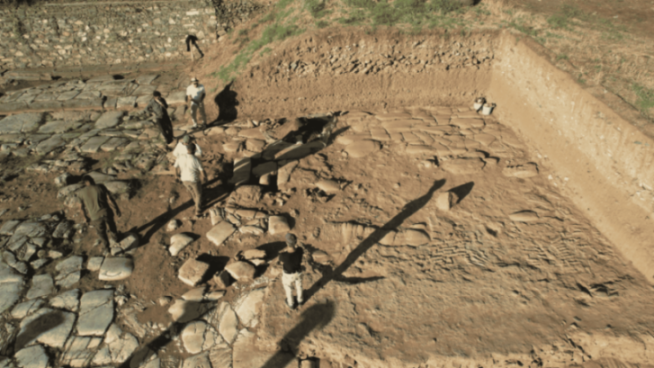
Mystery statue unearthed at Sardis archaeological dig
Mystery statue unearthed at Sardis archaeological dig Photos © Archaeological Exploration of Sardis/President and Fellows of Harvard College Sy Boles Ha...

Home is at the heart of Parton’s music, author says
Martha Ackmann. Photo by Kevin Grady Home is at the heart of Parton’s music, author says Martha Ackmann tells Radcliffe audience the origin story of a songw...

‘Pop Culture Jeopardy!’ champs knew they had film covered. TV? Not so much.
Jack Goldfisher (left) and Henry Johnson.Photo courtesy of Jack Goldfisher ‘Pop Culture Jeopardy!’ champs knew they had film covered. TV? Not so much. J...
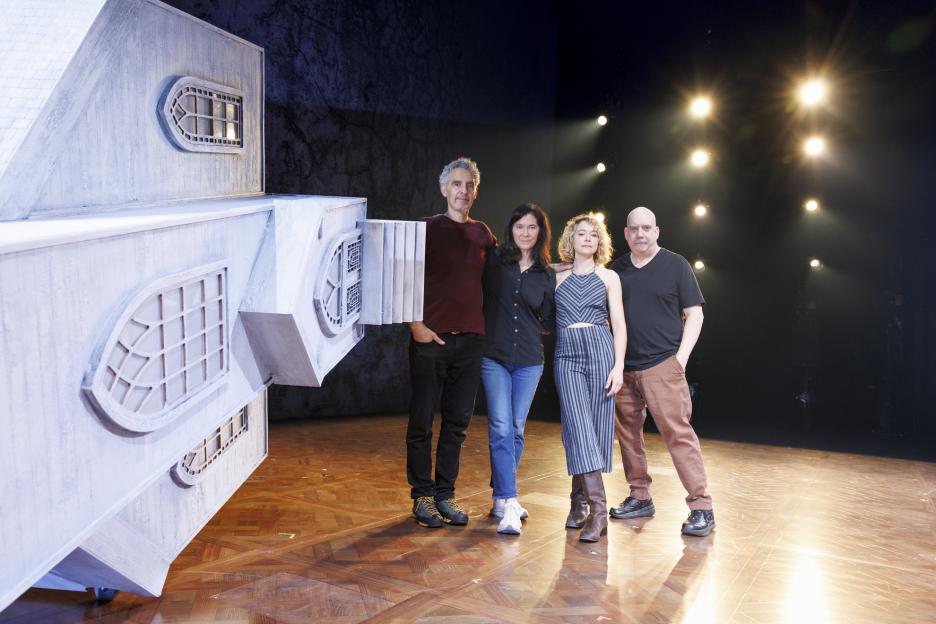
Holding onto your humanity, against the herd
John Turturro (from left), Diane Paulus, Tatiana Maslany, and Paul Giamatti. Niles Singer/Harvard Staff Photographer Holding onto your humanity, against the h...