Lauren Groff’s poet alter ego
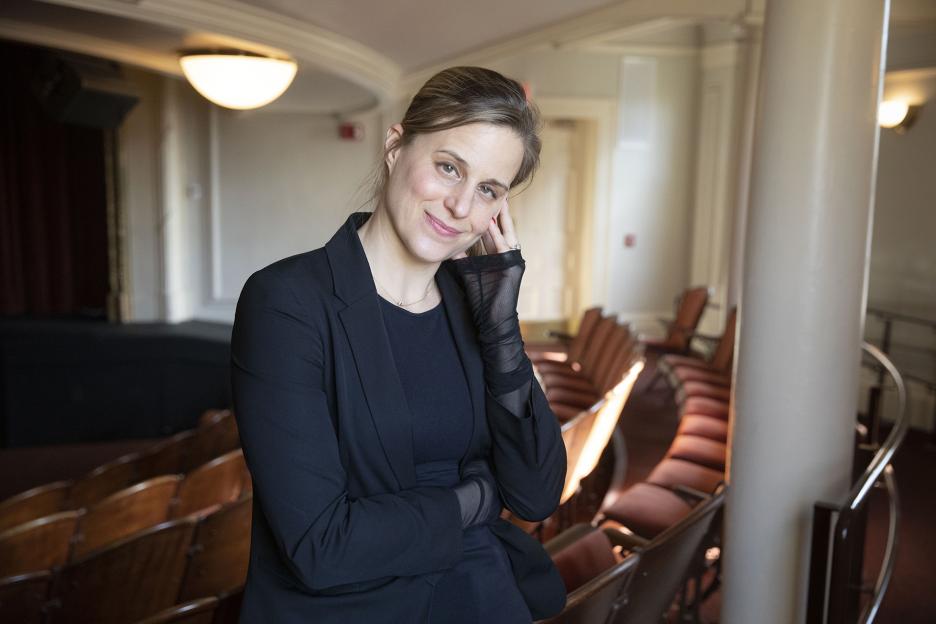
Harvard file photo
Liz Mineo
Harvard Staff Writer
Writer lets secret slip in Radcliffe talk
Lauren Groff stunned her interviewer at a recent Harvard Radcliffe Institute talk when she revealed she has published poems under a pen name.
“I do write poetry and I publish it, but not under my name,” said the acclaimed author of short stories and novels with mischievous laughter, in response to a question by fellow writer Gish Jen ’77, a 2002 Radcliffe fellow, who was moderating the first installment of the Virtual Radcliffe Book Talks series.
“Whoa,” said Jen. “Oh my goodness. This has not come out before. An alias … fascinating.”
Groff, a three-time National Book Award finalist, is the author of the novels “Monsters of Templeton,” “Arcadia,” “Matrix,” “Fates and Furies,” and “The Vaster Wilds,” as well as the collections of short stories “Delicate Edible Birds” and “Florida.”
The 2019 Radcliffe Fellow has in the past credited poet Emily Dickinson as the reason she became a writer. At last week’s talk she said that she reads poetry in the morning to start the day with “a jolt of literary caffeine.” But she has said very little of her own poetry until now. Groff didn’t disclose her pseudonym, and Jen didn’t ask Groff to reveal it.
“Poets can do things that I think prose has a really hard time doing,” said Groff. “In poetry, the speaker can float; it doesn’t have to be an obvious speaker. There’s a lot of compression that has to happen in a poem that sometimes you can’t really do it in a novel or short story.”
Among Groff’s favorite poets are Terrance Hayes, Natalie Diaz, Ada Limon, Walt Whitman, and of course Dickinson, but she said she is fond of way too many poets to list them all. She praised Devon Walker-Figueroa’s 2025 poetry collection, “Lazarus Species.”
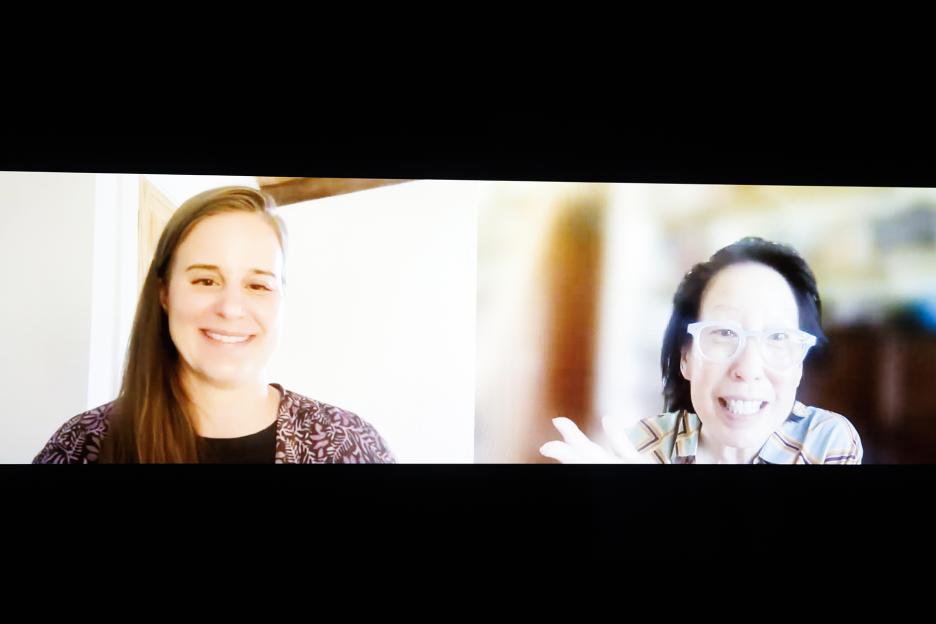
Gish Jen (right) interviews Groff during the virtual talk.
Veasey Conway/Harvard Staff Photographer
The conversation also touched on Groff’s writing process, inspirations, and “Brawler: Stories,” her latest collection of short stories that deal with themes of love, fear, and violence. The stories in “Brawler” were inspired by Groff’s exploration of the “overall macrocosm of violence in North American cultures, particularly the United States culture, and the way that it can be reflected often in the family unit.”
Of her writing process, Groff said she likes to work on different projects at the same time. “If I obsess too much about one thing, that thing will never get done,” said Groff, who co-owns with her husband The Lynx Books in Gainesville, Florida, where she lives. “But if I can sort of partition out my obsessions into three or four different projects, then I feel as though I’m not putting all the weight into that one thing.”
Groff has worked on some books for decades, not only because some stories take time to develop in her subconscious, but also because she sees them as “living entities” that need time to grow and take shape, like children.
“One has to allow them to grow and to come to you with the amount of time it takes for them to grow,” she said. “You can’t force a book to do what it needs to do. You can’t force it to come to you in its wholeness.”
Groff said she has learned to wait. “Maybe it’s not the right time to tell it, maybe you haven’t found the right form in which to tell it, or maybe you’re just not wise enough to tell it yet,” she said.
A graduate of Amherst College, Groff earned an M.F.A. from the University of Wisconsin-Madison. Groff spoke fondly of her time at Radcliffe, where she came up with the idea for “Matrix,” a historical novel based on the life of medieval writer Marie de France.
“Radcliffe radically changed my life because it gave me that book and sort of the triptych of books that I’ve been working on since 2019,” said Groff.
Published in 2021, “Matrix” is the first installment of Groff’s triptych followed by “The Vaster Wilds,” set in Virginia in the early 1600s, which came out in 2023.
Asked about the book that could potentially complete her triptych, Groff shared she is planning to explore religion, a topic she finds both fascinating and moving because “each religion in the world shows humans struggling and grappling with things that we cannot possibly understand.”
“What I wanted to do with this is to wrestle with the ideas of Western religion and the way that religion and the way we treat the natural world is like the way that we treat women,” said Groff.
“I started in the medieval time with Marie de France, and then I went on to a Protestant coming to the New World, and this very hungry capitalist way. And the third one is set now, and that’s all I can say about it. But it’s still wrestling with God. I’ll never stop wrestling with God.”