

Daniel Mason never thought he’d write a comedy. Then came Miles.
Daniel Mason never thought he’d write a comedy. Then came Miles. © Sara Houghteling Samantha Laine Perfas Harvard Staff Writer July 22, 2026 7 min...
 Written by Eze Chidiebere
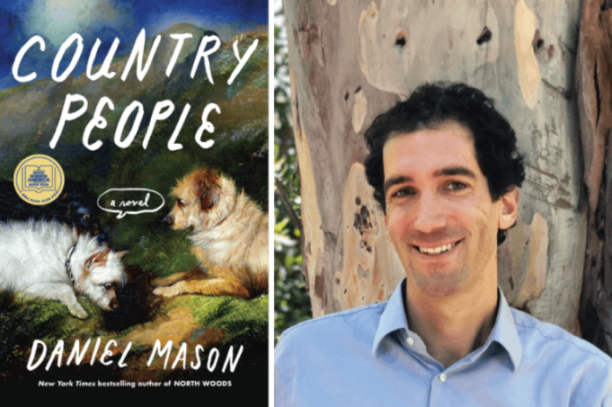
Daniel Mason never thought he’d write a comedy. Then came Miles.
© Sara Houghteling
Samantha Laine Perfas
Harvard Staff Writer
Award-winning novelist details path he followed to write ‘Country People’
An academic superstar, her devoted husband, two kids, and dog pack up in the Bay Area of California and head out on a great American road trip to start the wife’s yearlong visiting professorship in rural Vermont.
So begins “Country People,” the fifth novel by award-winning author and psychiatrist Daniel Mason ’98. The story centers around the husband, Miles, as he tries to embrace small-town life and finish the dissertation he’s been nursing for 14 years, all while battling his own wandering sense of purpose and place in the world.
In an interview with the Gazette, which has been edited for clarity and length, Mason discussed how looking closely at some of life’s small but beautiful moments can be rich fodder for storytelling.
What was the inspiration for the novel?
When I wrote my last book, “North Woods” (2023), I spent a year out in Western Mass., Southern Vermont, and upstate New York doing research, and there were a number of characters there that remained with me even after I was done.
I also found myself continuing to think about the comedy of our family of city people picking up for a year and trying out rural life — with all our preconceptions and fantasies about what that might be.
I started writing little scenes, not thinking it would actually become anything. Over time I was more drawn in by Miles and after a few months I decided, “OK, I’m going to try this.”
The book is very playful. Was the creative process the same?
Definitely. My other books use humor from time to time, but it’s often accidental or incidental. “North Woods” had a bit more, but I’d never deliberately set out to write a comedy.
At first I was quite worried about that — writing something contemporary was already new for me, but a comedy? The idea of telling a joke and it falling flat is a horrible thing that we can all relate to, but 300 pages of jokes falling flat would be really embarrassing.
That held me back, but the more I wrote, I enjoyed it a lot. Miles turned out to be the kind of character who went anywhere, and it was a lot of fun to follow him — I’d be laughing to myself as I wrote.
The reader gets to witness the internal dialogues of many of the characters as they struggle to connect. How do the characters find — or fumble — relationships with one another?
Miles is a person who is very open to people, but at the same time, there’s a loneliness there.
A theme that emerges early in the book is the difference between the connections he has in his life versus the connections that his wife has in her life. She has a very rich network of friends, from her academic circles, social networks, back home, or in town, whereas Miles has sort of gone his own way while still being very devoted to the family.
I didn’t have to go very far to notice this pattern in my own life and a lot of my peers’. As I was writing the book, I kept seeing articles and academic papers about male loneliness and the struggle for men to find real connection.
Miles is interesting because he does find friends, but they’re like a bunch of little islands. They’ll connect over their trees, their gardens, or (later in the book) a shared interest in the Hollow Earth legend. But loneliness is pretty persistent.
“Miles turned out to be the kind of character who went anywhere, and it was a lot of fun to follow him — I’d be laughing to myself as I wrote.”
Throughout the book Miles is on an unending journey to finish his dissertation. In one sense he gets nothing done, but he also has a very full life. What does this tell us about him?
This is something that one sees in academia all the time: People are drawn earlier in their life to academia and are passionate about an idea, but that’s very different than fully executing a project.
This is something I’ve experienced, where I might be excited about something but maybe it’s not the thing I want to do with my life. That’s Miles. He’s a person who’s really interested in almost anything he comes across but still doesn’t know how to find his place.
How did you find the right voice for this novel?
I think it developed over time. The voice is pretty different from my first, mostly historical novels.
“North Woods” covers a wider span of time with different historical voices, and later in the book, in a chapter about an amateur historian, Morris Lakeman, I found myself writing in a contemporary voice, in what’s called free indirect discourse — which is third-person access to a character’s inner thoughts with the emotional inflection as they might have them.
I love this voice. “Madame Bovary” (one of my favorite books) is considered the great classic example; Virginia Woolf uses it magnificently as well. As I tried it out in “North Woods,” I loved it, and in this book, found it fit the wandering thoughts of Miles really well.
In using that voice, the reader is privy to all of these unfiltered glimpses into what characters are thinking and feeling. What’s the benefit of that insight?
Often those little anecdotes can say so much. As a writer, I’ve moved from detailed physical description to focusing more on little things that might shed light on a person’s personality.
Earlier in my career, I had a prejudice I should write about “big” things, like war, love, nature (and more recently, climate change).
But in this book, I found that looking even at seemingly mundane moments could offer a different kind of insight. Like, for example, when Miles has this trivial question about whether he should wear jeans or sweatpants to meet a friend at his apple orchard for the first time. It’s trivial, but we learn a lot about him: about his indecision, his uncertain relationship between himself as a city person versus his fantasy of himself as a country person, about belonging, about insecurity.
That was one of the unexpected parts of writing, this opportunity to look at the stuff of everyday life — a kid’s school play, a trip to the emergency room — and see what light it can shed.
One part of the novel involves a community of people who believe the Earth is hollow, and they spend their time looking into a local legend. What did you feel that added to the plot?
Many of us these days wonder: Why do people believe things that aren’t true? I didn’t set out thinking that the “Hollow Earthers” in the book would answer that question.
Initially, I wanted to find a legend that would draw Miles in. Later, there is another character, known as Snowflake Bentley, whom Miles meets in the emergency room, who voices some of the more theoretical questions about the taxonomy of imagination: Where does the boundary lie between phenomena that seem related? What is a conspiracy theory and what is a legend?
There is a continuum, and sometimes it’s hard (even in my professional life as a psychiatrist) to pinpoint the difference between imagination and delusion.
How did you feel you grew as a writer, writing a comedy for the first time?
It was freeing. It gave me an awareness that the world around me has elements which, at first, seem simple — but only because I wasn’t looking more closely at them.
I worry a lot about the state of the world, and in the past have used history as a kind of lens to see it from a distance. Using humor provided a very different kind of lens.


Related articles
Mystery statue unearthed at Sardis archaeological dig
Mystery statue unearthed at Sardis archaeological dig Photos © Archaeological Exploration of Sardis/President and Fellows of Harvard College Sy Boles Ha...
Home is at the heart of Parton’s music, author says
Martha Ackmann. Photo by Kevin Grady Home is at the heart of Parton’s music, author says Martha Ackmann tells Radcliffe audience the origin story of a songw...
‘Pop Culture Jeopardy!’ champs knew they had film covered. TV? Not so much.
Jack Goldfisher (left) and Henry Johnson.Photo courtesy of Jack Goldfisher ‘Pop Culture Jeopardy!’ champs knew they had film covered. TV? Not so much. J...

Holding onto your humanity, against the herd
John Turturro (from left), Diane Paulus, Tatiana Maslany, and Paul Giamatti. Niles Singer/Harvard Staff Photographer Holding onto your humanity, against the h...