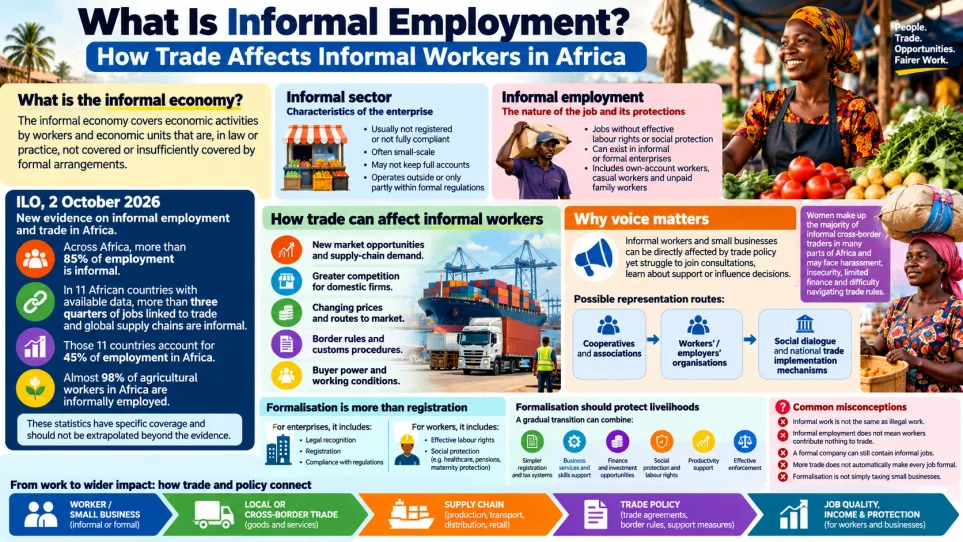
Informal work is central to how millions of people earn a living across Africa. Street traders, farmers, transport workers, home-based producers, craftspeople and workers inside businesses can all be part of the informal economy. Yet “informal” does not simply mean unregistered business, illegal work or very small enterprise.
Understanding the distinction matters because trade policies, supply chains and efforts to formalise economies can affect workers differently depending on the kind of job they have and the protections available to them.
What is the informal economy?
The International Labour Organization (ILO) describes the informal economy as economic activities by workers and economic units that are, in law or in practice, not covered or insufficiently covered by formal arrangements.
This definition is broader than the idea of an unregistered street business. It includes questions such as whether workers have effective labour protections, social security and recognised employment arrangements.
Informal sector and informal employment are not the same thing
The informal sector describes characteristics of an enterprise or economic unit. An enterprise may be small, unregistered or only partly covered by formal regulatory systems.
Informal employment, by contrast, concerns the nature of a person's job. A worker may lack effective labour or social protection even when working for an enterprise that is itself formally registered. Informal jobs can therefore exist in both formal and informal enterprises.
This distinction prevents a common mistake: counting registered businesses and assuming every person working for them necessarily has a formal job.
How common is informal employment in Africa?
ILO research published on 2 October 2026 reports that more than 85% of employment across Africa is informal. Informality is particularly widespread in agriculture, where almost 98% of workers are informally employed.
The same research examined trade-linked employment in 11 African countries for which suitable data were available. Those countries account for about 45% of employment on the continent. More than three quarters of jobs linked to trade and global supply chains in that group were informal.
These figures need to be read carefully. The 11-country trade analysis is not a measurement of every African country, and its findings should not simply be extrapolated to places outside the study.
How can trade affect informal workers?
International and regional trade can affect informal workers through several channels.
New markets and supply-chain demand: Export activity or regional integration can create demand for farming, processing, transport, retail, repair and other services.
Competition: Domestic producers may face stronger competition from imported goods or larger suppliers. Some firms gain opportunities while others have to adapt.
Prices and routes to market: Changes in tariffs, transport costs, exchange rates or supply chains can affect the prices workers receive and the costs they pay.
Border procedures: Customs rules, documentation requirements and border infrastructure can have a particularly direct effect on small-scale cross-border traders.
Buyer relationships: Workers and small producers connected to larger supply chains may depend on powerful buyers. Market access alone does not guarantee decent wages, predictable income or adequate protection.
Does more trade automatically create formal jobs?
No. The ILO's 2026 analysis found that trade-linked employment had lower informality than non-trade employment in the countries studied, by about 8.1 percentage points. That is an association, not proof that increasing trade by itself causes jobs to become formal.
Trade interacts with labour institutions, business regulation, productivity, social protection, enforcement, education, infrastructure and many other factors. Two economies can participate in similar markets while producing very different outcomes for workers.
Why does representation matter?
Trade rules are often discussed at national or international level, but their consequences can reach a farmer, market trader or small transport business directly.
ILO consultations involving more than 70 stakeholders in Ghana, Kenya, Mozambique, South Africa and Uganda found that established consultation systems often struggle to include informal workers and enterprises. People affected by a policy may therefore have difficulty learning about support programmes or influencing decisions.
Representation can occur through cooperatives and associations, workers' organisations, employers' organisations and social-dialogue mechanisms. These organisations can help translate the experiences of dispersed workers and businesses into evidence that policymakers can use.
Women and informal cross-border trade
Women make up a large share of informal cross-border traders in many parts of Africa. Their work can support household income and regional commerce, but traders may face insecurity, harassment, limited access to finance and difficulties navigating border requirements.
Improving trade systems therefore involves more than moving goods faster. Safe border facilities, understandable procedures, access to information, finance and meaningful representation can influence who benefits from regional trade.
What does formalisation actually mean?
Formalisation is often reduced to “register the business and pay tax”. That is incomplete.
For enterprises, transition towards formality can involve legal recognition, appropriate registration, accounting and compliance with relevant regulation. For workers, it involves effective labour rights and social protection, which may include protections relating to health, pensions, maternity, injury or unemployment depending on the national system.
The ILO's approach treats formalisation as a transition rather than a single administrative event.
Why should formalisation protect livelihoods?
A poorly designed policy can impose costs on very small businesses without giving workers or entrepreneurs meaningful benefits. A more balanced transition can combine simpler registration and tax systems with business services, access to finance, social protection, labour rights, productivity support and effective enforcement.
The aim is not to eliminate people's livelihoods. It is to reduce vulnerability while improving the conditions under which productive businesses and decent jobs can grow.
A simple way to understand the trade connection
Consider a small food producer selling locally and occasionally across a border. The producer depends on workers, transport, suppliers and buyers. A change in customs procedures may alter the cost of reaching customers. A larger buyer may create new demand but also impose strict prices or delivery conditions. If the enterprise grows, registration and finance may become more useful, while workers may need stronger labour and social protections.
The chain can be summarised as: worker or small business → local or cross-border trade → supply chain → trade policy → effects on job quality, income and protection.
Common misconceptions
“Informal work is illegal work.” Not necessarily. Informality concerns insufficient coverage by formal arrangements; it is not synonymous with criminal activity.
“Informal workers do not participate in international trade.” They can participate directly through cross-border commerce or indirectly through supply chains.
“A registered company means every job is formal.” No. Informal employment can exist within a formal enterprise.
“More trade automatically makes jobs formal.” No. Trade can create opportunities, but job quality depends on many institutions and policies.
“Formalisation just means taxing small businesses.” No. A meaningful transition includes rights, protection, legal recognition and access to systems that can support productivity.
Practical implications
For policymakers, good trade policy should examine who performs the work behind traded goods and services, not only the headline value of exports. For worker and business organisations, reaching informal workers can improve the evidence used in negotiations. For entrepreneurs, understanding registration, labour obligations, border procedures and available support can make growth decisions more informed.
For learners and researchers, the most important habit is to distinguish enterprise status from employment status and to check exactly which population a statistic describes before applying it more widely.
Key takeaways
- Informal employment describes the nature and protection of a job; it is not identical to the informal sector.
- ILO research reports that more than 85% of employment across Africa is informal.
- In 11 African countries with suitable data, more than three quarters of trade- and supply-chain-linked jobs are informal.
- Trade can create opportunities while also changing competition, prices, border requirements and bargaining relationships.
- Trade participation alone does not guarantee formal or decent employment.
- Formalisation should combine appropriate enterprise compliance with effective rights, social protection and productivity support.
Frequently asked questions
Is informal employment the same as unemployment?
No. A person in informal employment is employed, but their job is insufficiently covered by formal arrangements or protections.
Can someone working for a registered company have an informal job?
Yes. Enterprise formality and employment formality are separate concepts.
Does informal mean illegal?
No. Informal economic activity is not automatically illegal. The concept concerns coverage by formal institutional and legal arrangements.
Why are informal workers important to trade policy?
They can produce, transport, process or sell traded goods and services, and policy changes can directly affect their income, costs and working conditions.
What can help workers move towards formality?
The appropriate mix differs by country, but measures can include accessible registration, suitable taxation, finance and business support, social protection, labour rights, productivity improvements and effective enforcement.
Authoritative references
- International Labour Organization, Making trade work for informal workers in Africa, 2 October 2026.
- International Labour Organization, statistical and conceptual framework on the informal economy and informal employment.
- International Labour Organization, Recommendation No. 204 concerning the Transition from the Informal to the Formal Economy.