

Are we headed toward recession? Unpredictable.
Are we headed toward recession? Unpredictable. Illustration by Matt Kenyon/Ikon Images Christina Pazzanese Harvard Staff Writer August 3, 2026 9 m...
 Written by Eze Chidiebere
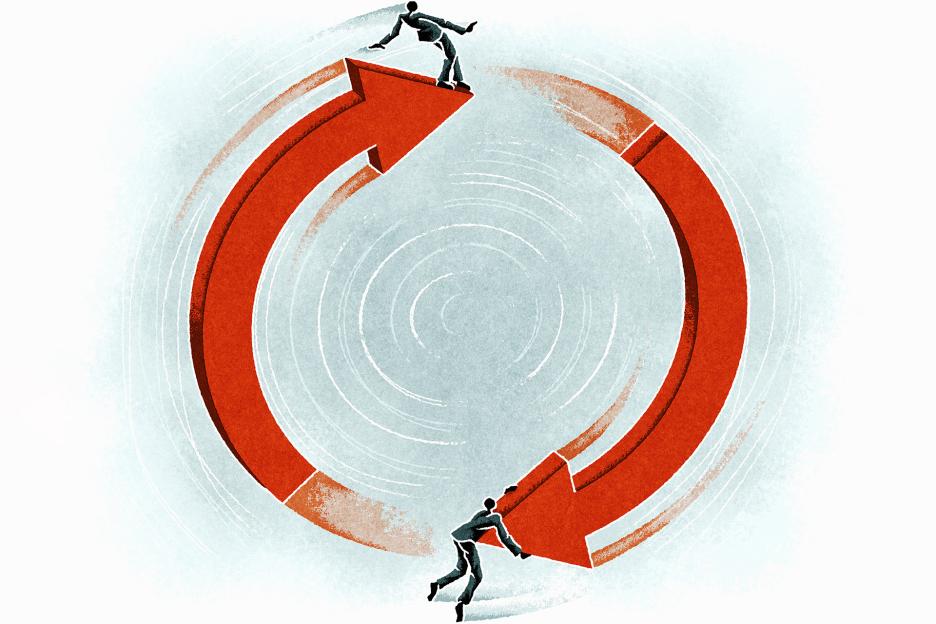
Are we headed toward recession? Unpredictable.
Illustration by Matt Kenyon/Ikon Images
Christina Pazzanese
Harvard Staff Writer
Economic historian rebuts various beliefs about cause, concerns around downturns, explains why expansions are more important anyway
Economists and Wall Street analysts frequently warn about what sounds like an immutable law of economic gravity : Growth that gets too hot for too long risks provoking an inescapable cool-down known as a recession.
But that notion is wrong, according to a new book about the history of recessions in the U.S. and U.K. dating back to 1700, “Recession: The Real Reason Economies Shrink and What to Do About It.”
Contrary to popular thinking, these “busts” are not the inevitable result of flaws in the economic “booms” that immediately precede them, and they’re not cyclical, or necessary, course correctives. In fact, recessions have relatively little effect on the economy over time compared to periods of growth, says the book’s author, Tyler Goodspeed ’08, M.A. ’11, Ph.D. ’14.
In this edited conversation, economic historian Goodspeed discusses what triggers recessions and why war is the most prolific “serial killer” of economic expansions over the last 400 years. He served as acting chair of the White House Council of Economic Advisers during President Trump’s first term and is now chief economist at ExxonMobil.
What’s the definition of a recession?
I adhere to the definition used by the National Bureau of Economic Research, which is a broad-based economic contraction that’s spread across sectors and that lasts for more than a few months.
I think armed only with a graph of the unemployment rate, one could do a pretty good job picking out historical recessions, which are typically characterized by the substitution of a sudden, sharp upward movement in the unemployment rate for a more gradual downward or sideways movement.
You say the conventional wisdom around why recessions occur is wrong. How so?
The stories we tend to tell ourselves about recessions is that there was something fundamentally wrong in the expansions that preceded them. There was some error, some excess, some imbalance, to which recession was the inevitable, maybe even necessary, outcome.
Fortunately, that view yields several empirically testable and falsifiable hypotheses.
First of all, if there was something wrong in a so-called boom to which the bust was the inevitable remedy, then we should expect expansions to die of old age. So the longer an economic expansion has been going on, the more those errors and excesses and imbalances accumulate, the likelier it is to die.
We would expect that higher, faster, longer economic expansions should be followed by deeper, faster, longer recessions.
We should expect that the frequency of recessions should be roughly constant across time and space.
We should expect that the economy should look fundamentally different at the end of an economic recession and subsequent recovery from how it would have looked in the absence of the recovery of the recession.
We should also expect that the increased role of the state should have attenuated the depth and duration of recessions, and we should also expect that recessions should be in some sense predictable, that there should be some indicators in the height, the speed, excess, whatever, in an economic expansion that should predict recession.
In reality, when I analyzed these 132 recessions going back to 1700, all of those hypotheses are rejected by the data. All of them. Expansions don’t die of old age; deeper, faster, longer recessions don’t follow higher, faster, longer expansions; recessions have become less frequent over time.
The U.K. has long been less recession-prone than the U.S.
Typically, economies look pretty similar at the end of a recovery to how they would have looked in the absence of a recession; and recession depth and duration have been remarkably constant over time.
And finally, they’re not predictable.
So, all those hypotheses generated by the boom/bust view are just rejected by the data.
Do recessions share any common patterns historically?
There are some things that are roughly constant across time and across space. The depth and duration of recessions have been pretty constant over time. Most recessions are over in about a year; the vast majority in fewer than two.
A key feature of recessions is a sudden sharp upward movement in the unemployment rate, and that’s typically driven in the first instance not by a sudden increase in the rate at which firms lay off workers, but rather a sudden collapse in the rate at which they hire workers.
Are they in any way avoidable or inevitable?
Recessions will continue to happen because history will continue to happen. There’s never been an immortal economic expansion.
One of the optimistic findings in the book is that recessions have become less frequent over time in both the U.S. and the U.K. That is a long-run structural trend going all the way back to 1700 with no clear break at any specific points in time toward longer-lived economic expansions.
What’s driving that is households, businesses, and consumers have been learning how to better absorb the kinds of shocks that historically would have generated recessions. Two examples: Our banking systems are generally more resilient, more diversified today than they were in the 19th century, and our energy systems have become a lot more diversified, both across fuel types and within fuel types.
You argue there are three categories of “shocks” that typically precede recessions. You call them “Acts of God,” like pandemics or severe weather that slows commerce or damages crops; “Acts of Man,” such as major bank fraud; and “Acts of Church,” which are state actions like imposing consumer credit controls. But you say there’s one thing that’s been “a prolific serial killer of economic expansions” over the last 400 years: war. Why is that and is that true for all armed conflicts?
Not all wars are created equal. What I’m talking about is either world war or war that visits your soil in a profound way.
Take some of the longest recessions in history for the U.K. and the U.S. The U.K. had a very protracted recession that began in 1943 during World War II and continued all the way till 1947. They also had a very long recession at the end of and in the immediate aftermath of World War I. Another very long recession during the Seven Years War in the 18th century.
In the U.S., we had a Depression-magnitude recession during the American Revolution, and in the immediate aftermath of the American Revolution during a very volatile period.
One of the most fascinating recessions I found looking back to 1700 was in the North American colonies from 1717 to 1720. This was the peak of the so-called Golden Age of Atlantic piracy.
You had the end of a major European war during which the British government had paid private sailors to become privateers. So, at the end of the war, there were all these unemployed sailors, and they turn to piracy.
Trade and commerce in the American colonies just ground to a complete halt. It was only after some of the most infamous pirate names were killed or captured or accepted the king’s pardon that you had a resumption of normal commercial flows.
Why is there always so much fretting currently over the possibility of a recession, given that they tend to be relatively brief and less frequent? It’s especially puzzling since the U.S. notched two of its longest economic expansions ever in the last few decades, and expansions exert greater overall influence on an economy.
There’s a lot of fretting because our minds don’t deal well with randomness, and at the end of the day recessionary shocks are random. So, we’re constantly searching for predictive patterns to recessions and embed those perceived patterns in parables of boom and bust.
But the moral, boom-bust stories we tell ourselves about recessions are not entirely innocuous because if it’s the case, as I find in the book, that economic expansions die healthy and innocent, then there is a risk that we as policymakers are perpetually seeking to sedate or otherwise overmedicate economic expansions that fundamentally die healthy and innocent.
And typically, a few years on from a recession, economies look pretty darn similar to how they would have looked had they continued uninterrupted along a long-run trend.
You touch upon a really important observation, which is that the majority of years in which economies expand matters more for long-run prosperity and indeed human flourishing. And so, we probably ought to be at least as concerned about raising that rate of trend growth as we are about avoiding recessions, because ultimately the periods of expansion matter more.
Despite recent “shocks” to the U.S. economy like tariffs, the war with Iran, the spike in fuel and energy prices, and workforce reductions attributed to AI, the country is not in a recession. What signs from history do you look for to help forecast whether one is on the horizon and how detrimental it might be?
Something that I learned is that it takes either a really big shock like a massive pandemic or a cluster of smaller shocks to push a large, diversified economy into a period of outright contraction. It takes a lot.
In terms of what I look for, recessions are typically characterized by a sudden sharp increase in the civilian unemployment rate. That’s the best real-time indicator of whether you’re in a recession. It can’t predict whether you’re going to be in a recession, but it’s a good indicator of whether you are.
I find that recessions are unforecastable. They’re unpredictable. However, what the book does equip one to do is to get a sense of the kinds of shocks that historically have contributed to recession, and then the reader can ask themselves, do I think the conditional probability is higher or lower than the unconditional probability? And in the past century, there’s been, in any given year, about a 1-in-100 chance of a pandemic-related recession; there’s been about a 1-in-10 chance in any given year of an energy-related recession in the U.S.

Related articles
Inflation Changes What the Same Money Can Buy: Understanding Purchasing Power
£1,000 can still be £1,000 years from now while buying considerably less. Understanding the difference between nominal money and real purchasing power helps explain inflation, wages, savings and long-term financial planning.

Gen Z puts high priority on jobs with meaning, purpose, but sees daunting hurdles
Gen Z puts high priority on jobs with meaning, purpose, but sees daunting hurdles Sy Boles Harvard Staff Writer August 3, 2026 7 min read Sch...
Furman on Social Security: Attention must be paid
John Nacion/Sipa via AP Images Furman on Social Security: Attention must be paid ‘Interest in the problem has diminished over time, not grown.’ Meanwhile, d...

20 societal problems, 20 solutions
20 societal problems, 20 solutions Jessica McCann Harvard Correspondent June 3, 2026 long read Projects translating research into public good...