

Don’t mince words, Radcliffe told scholars. It worked.
Don’t mince words, Radcliffe told scholars. It worked. Photo courtesy of Harvard Radcliffe Institute Jacob Sweet Harvard Staff Writer July 31, 2026...
 Written by Eze Chidiebere
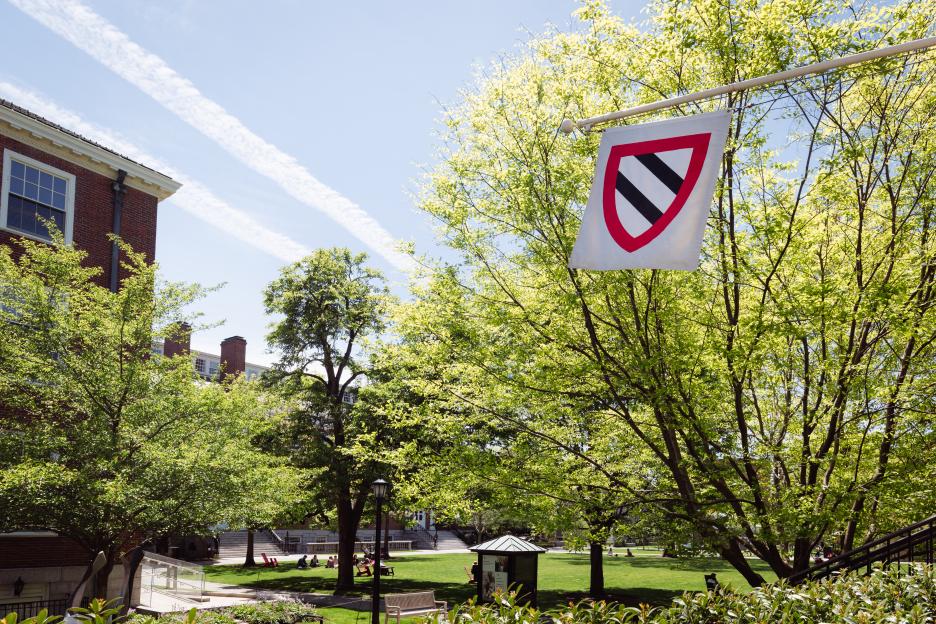
Don’t mince words, Radcliffe told scholars. It worked.
Photo courtesy of Harvard Radcliffe Institute
Jacob Sweet
Harvard Staff Writer
Participants in intellectual diversity initiative navigated deep disagreements on path to consensus
When exploring different sides of an issue, a devil’s advocate can play-act an opposing perspective, but the exercise has limits. It’s better to talk to someone who genuinely disagrees with you.
“You actually have to make the effort to get people in the room who deeply believe in, think about, and live by a certain set of aspirations or ideals,” said Jenna Silber Storey , co-director of the Center for the Future of the American University at the American Enterprise Institute, a conservative think tank. When faculty members discuss intellectual diversity on college campuses, it’s not enough, she said, to “theoretically entertain what political conservatives might think.”
Dean Tomiko Brown-Nagin of the Harvard Radcliffe Institute agrees. When she convened a workshop on intellectual diversity last November, she and her co-leads, Harvard Ed School historian Julie Reuben and Keith Whittington of Yale Law School, took care to choose scholars and leaders whose wide range of political and ideological perspectives would put their commitment to collaboration to the test.
The group proved up to the challenge, in May publishing a white paper Brown-Nagin described as “a true negotiated document that reflected consensus.”
Storey, one of the 15 authors of the paper, credited the success of the effort in part to Radcliffe’s insistence on a truly diverse mix of thinkers.
“Simply the fact that the Harvard Radcliffe Institute invited a significant number of political conservatives to discuss this question was astonishing to many people on the political right,” she said. “It just signals right off the bat: We’re going to take your opinion seriously; we’re inviting you to be equal parts in drafting this statement.”
In the paper, “Intellectual Diversity and the Mission of Higher Education,” the authors came to several shared conclusions. They agreed that universities are facing a legitimacy crisis, in part due to public skepticism of higher education’s civic value. The tendency of faculty and students to skew more liberal than the general population is one important contributor to that skepticism, the authors found.
More concerning, “students and faculty do not feel fully free to express themselves on certain issues,” the white paper states. The group advocated for programs on campus to replace a “censorious culture with one that is more open to debate and disagreement,” adding: “We are largely united in the view that most colleges and universities simply do need more ideas and methodologies often associated with political conservatism in order to achieve their mission.”
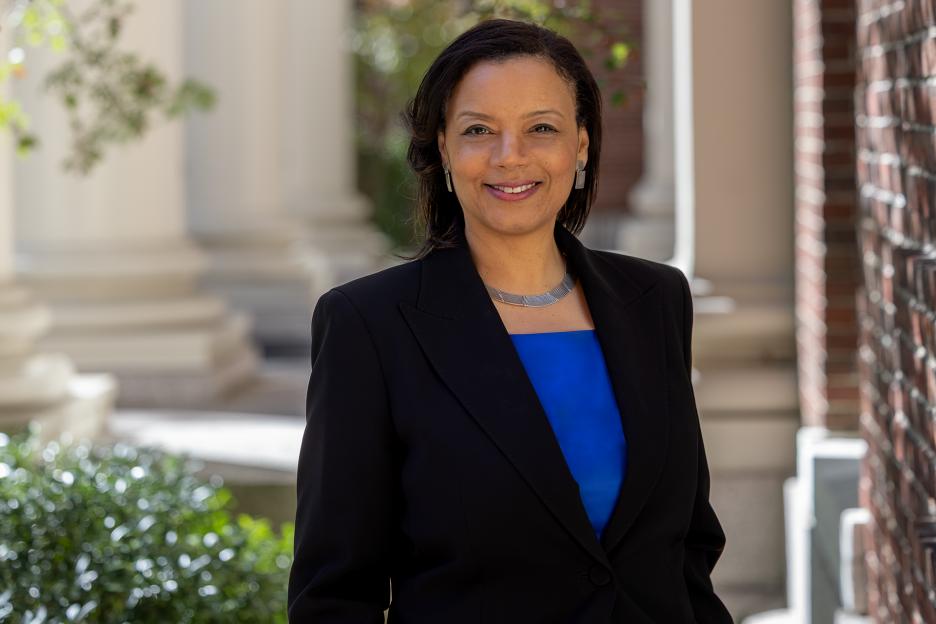 Tomiko Brown-Nagin.
Photo by Melissa Blackall
While the group discussed areas from research to governance, they agreed that they didn’t have as much information as they needed to both diagnose and solve problems. “In the absence of rigorous evidence, it is exceedingly difficult to define precisely the problem we face and to make progress toward solving it,” the document says.
As an example of the research that would help, the authors highlighted surveys and analyses performed by workshop participants Neil Gross , a sociologist at Colby College, and Jon A. Shields , a government professor at Claremont McKenna College, and called for more study of topics such as course content and teacher and student experience.
As an outgrowth of the white paper, Brown-Nagin said that Radcliffe will soon announce a research project that will include surveys of faculty and students to clarify “the extent of political skewing on university faculties, why that might happen, and most important what, if anything, it means for classroom dynamics.”
The group also used the paper to highlight where they could not come to an agreement. Though they reached consensus on wanting a wider range of perspectives, they disagreed about whether universities should hire directly for ideological diversity.
Brown-Nagin, for one, pushed back against the idea that a faculty member’s political orientation inherently deprives students of a full range of ideas. Part of what people have attacked as politically skewed teaching, she said, is likely ineffective teaching — “faculty not having the tools to actually facilitate a conversation about a hot-button topic in class.”
“If what passes as political indoctrination is just a matter of faculty not having the right teaching tools, we can give them additional tools so that they can teach more effectively,” she said. At the Bok Center , she noted, Harvard offers courses on promoting healthy classroom dialogue, which are now mandatory for teaching fellows in the Faculty of Arts and Sciences.
Along the same lines, students’ reticence to speak on controversial issues might not be the result of faculty pressure. The 2024 report from Harvard’s Open Inquiry and Constructive Dialogue working group, co-led by Brown-Nagin, “found that fear of student judgment, rather than faculty retribution, is the primary motivation for most self-censorship,” she said.
“It’s important both to train faculty and to cultivate the right mindset and teach the right skills to students,” she added. She hopes that some of the new educational modules for incoming students across the University can help prepare them for deeper classroom discussions.
Reuben stressed that, while contemporary debates about academic freedom criticize universities as overly liberal, the ideological makeup of academia has shifted over time. For much of the 20th century, she said, “there was, if anything, less tolerance for what we might consider the progressive end of the spectrum than the conservative end of the spectrum.” It took decades, beginning in the 1960s, for a more progressive faculty to ascend.
Brown-Nagin expanded on the same point.
“Concerns about political indoctrination stretch far back into our history,” she said, from promoting certain narratives about slavery and the Civil War in the early 1900s to McCarthyism decades later. “There have long been fears that faculty are teaching the wrong subjects, that these politics are invading the classroom. And these concerns span the political spectrum.” It’s important, she said, to appreciate that the pendulum swings in both political directions — and that that pattern will likely continue over time.
As conversations about intellectual diversity continue, Reuben hopes that people pay attention to the paper’s emphasis on promoting professional norms among faculty. As a historian, she draws inspiration from the American Association of University Professors’ 1915 Declaration of Principles on Academic Freedom and Academic Tenure.
The white paper quotes the principles directly:
If this profession should prove itself unwilling to purge its ranks of the incompetent and the unworthy, or to prevent the freedom which it claims in the name of science from being used as a shelter for inefficiency, for superficiality, or for uncritical and intemperate partisanship, it is certain that the task will be performed by others — by others who lack certain essential qualifications for performing it, and whose action is sure to breed suspicions and recurrent controversies deeply injurious to the internal order and the public standing of universities.
In other words, Reuben said, faculty need to “step up and take responsibility for these things” — or others will do it for them.


Related articles
‘Very excited to start this new chapter of my life’
‘Very excited to start this new chapter of my life’ August 28, 2026 1 min read Scenes from the Yard on move-in day As Harvard’s Class of 2030 arrive...
‘Excited and a bit nervous … but mostly excited’
‘Excited and a bit nervous … but mostly excited’ August 28, 2026 1 min read Scenes from the Yard on move-in day As Harvard’s Class of 2030 arrived i...
Hope, joy, heavy lifting
Members of the Crimson Key Society welcome first-year students to Harvard.Photo by Grace DuVal Hope, joy, heavy lifting Anna Lamb Harvard Staff Writer...
One answer but with more than one way to get there
Jon Star. Niles Singer/Harvard Staff Photographer One answer but with more than one way to get there Liz Mineo Harvard Staff Writer August 17, 202...