

Policy changes for international students, scholars threaten U.S. competitiveness
Lenin Nolly/NurPhoto via AP Policy changes for international students, scholars threaten U.S. competitiveness Garber offers assessment at D.C. event, says s...
 Written by Eze Chidiebere
Lenin Nolly/NurPhoto via AP
Policy changes for international students, scholars threaten U.S. competitiveness
Garber offers assessment at D.C. event, says shifts will discourage global best, brightest from coming here for research, study
Alvin Powell
Harvard Staff Writer
The biggest threat to research universities from recent federal policy shifts aimed at them is not that those changes chase promising American scholars abroad but that they discourage the world’s best and brightest from coming here to do their work.
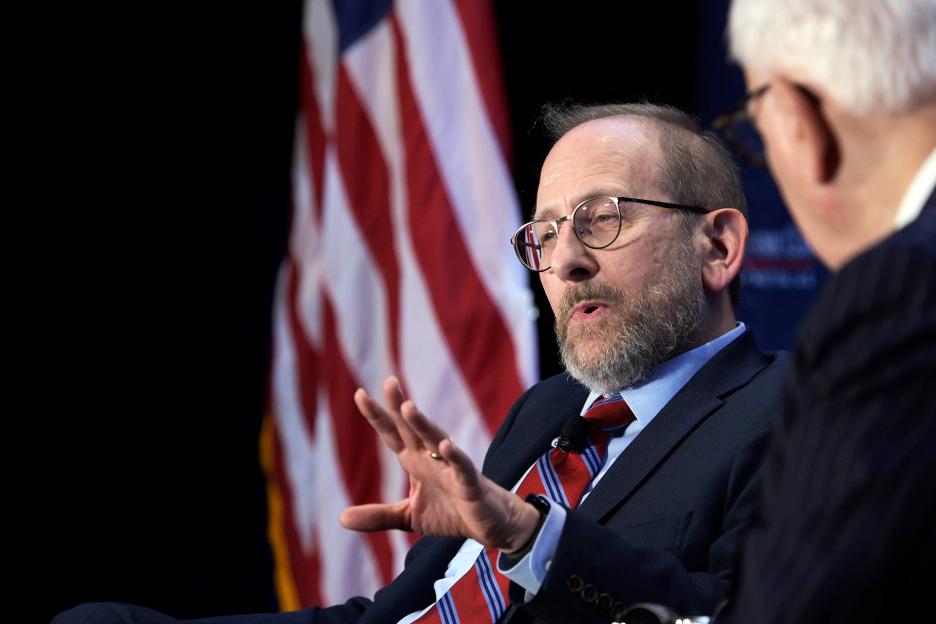
That assessment was offered by Harvard President Alan Garber on Thursday at The Economic Club of Washington D.C., a nonprofit association of Washington D.C.-area business leaders.
During the hourlong discussion with club Chairman David Rubenstein,
Garber also noted how much excitement remains in the scientific community, despite the headwinds.
“This is a time when the speed of scientific advances is simply unprecedented,” he said, adding, “We are on the cusp of major, major breakthroughs.”
He said his assessment of the state of research in America reflects the fact that the ability to attract talent from everywhere to work alongside U.S. scientists has long been a difference-maker for the nation as a global leader in research and innovation.
But now, he said, that flow is in peril from a slate of changes intended to restrict and discourage entry by international students and scholars
As an example, Garber cited a new federal rule, finalized in mid-July, that caps at four years the time students can stay in the U.S. without seeking additional government permission. Formerly, they were allowed to remain until they finished their studies.
The shift presents a particular problem for Ph.D. candidates because completing their degree takes six years on average, and some require even more time, owing to the complexity of their research.
The lack of a guarantee that they’ll be able to finish their studies serves as a deterrent to choosing an American graduate program, robbing the U.S. of global talent even as it enriches other nations, Garber said.
“If we send the signal that immigrants are not welcome here, we are giving up access to most of the talent in the world,” Garber said. “That is not a negative statement about U.S. talent. We have fantastically talented people. But talent is widely distributed, and if we say most of the world is off limits we can’t hope to compete at the highest level.”
Garber said that Harvard hasn’t lost many faculty members to other nations, but the chilling effect has been noticed with respect to postdoctoral researchers.
“We are feeling this immediately when it comes to postdoctoral scholars,” Garber said.
Over the past year and a half, the federal government has sought to exert control over areas of University governance that Garber has argued would violate academic independence and the University’s First Amendment rights.
The government has responded to Harvard’s resistance by cutting off research funds to the University and threatening to deny visas to international students seeking to study there.
Both actions have been blocked by federal courts and are being appealed.
“This is not a question about whether we settle with the Trump administration,” said Garber, who declined to answer questions about specific lawsuits. “This is about the relationship between the federal government and America’s universities. And it’s particularly true for America’s research universities because research funding has been withheld in order to force agreements about some issues that, for us and for other universities, cross red lines having to do with the ability of universities to use their judgment in deciding what kind of research to perform, which students they should admit, which faculty should be hired, what we teach, and so on.”
Related articles
Survey of young researchers raises concerns over future of science in U.S.
Raffaella Sadun. Stephanie Mitchell/Harvard Staff Photographer Survey of young researchers raises concerns over future of science in U.S. Fewer planning car...
A new diplomacy for 21st century as economic, political, tech power shifts
Julian Simcock (left) and Nicholas Burns.Niles Singer/Harvard Staff Photographer A new diplomacy for 21st century as economic, political, tech power shifts...
Making the case for independent science
Making the case for independent science Albert-László Barabási. Veasey Conway/Harvard Staff Photographer Alvin Powell Harvard Staff Writer August 21...
What the framers were really thinking
What the framers were really thinking Liz Mineo Harvard Staff Writer August 12, 2026 7 min read Origin story of Declaration of Independence in...