

When everything is politics on campus
Neil Gross.Photo by Jessica Berger Gross When everything is politics on campus Sociologist Neil Gross argues polarization undermining education opportunitie...
 Written by Eze Chidiebere
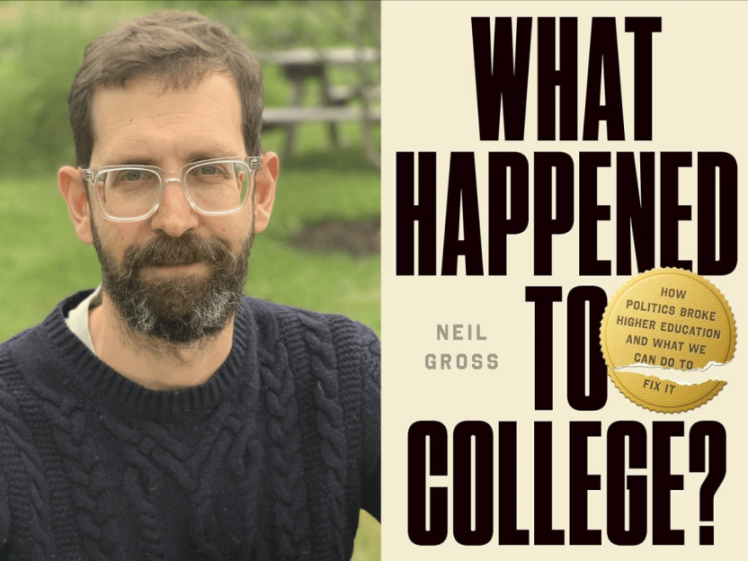
Neil Gross.
Photo by Jessica Berger Gross
When everything is politics on campus
Sociologist Neil Gross argues polarization undermining education opportunities, lays out how students might change things
Jacob Sweet
Harvard Staff Writer
Colby College sociologist Neil Gross says he thought he had a sense of the level of polarization on American college campuses based on his prior research.
But Gross, author of the new book “What Happened to College,” said in an interview that he was surprised by how much things had changed in the recent decades.
“I didn’t realize how far it had gone,” said Gross, who is currently conducting research on intellectual pluralism and changing scholarly habits at the Radcliffe Institute. “I think that was the biggest surprise — just the extent of it.”
Gross’ book breaks the divisiveness into two types: ideological and affective.
Ideological polarization is what happens when people’s beliefs drift further apart. Democrats become more liberal, and Republicans become more conservative.
Affective polarization, the core concept of Gross’s book, is arguably more insidious and counter-productive.
It’s when certain beliefs and affiliations become an increasingly large aspect of one’s identity and a basis for how to judge others. People begin to feel more positively about people who share their set of views and more negatively about those who differ.
Gross, the Charles A. Dana Professor of Sociology at Colby, taught at Harvard in the mid-2000s. He argues in his book that since the 1990s affective polarization has outpaced ideological.
“[T]he negative feelings some Americans have toward the other side increasingly involve disdain or hatred tied to the sense that people with opposing political beliefs are immoral,” he writes.
The trend isn’t limited to college campuses, but it’s there they have become a major talking point. Many students find themselves contending with sharp and caustic divides.
Drawing on hundreds of interviews and a trove of survey data, Gross argues that affective polarization shapes students’ experience before they even arrive.
“There’s a lot of writing off of whole colleges, whole states, whole populations, because of stereotypes about what people on the other side might believe, think, hold dear,” he said.
In one of many case studies in the book, he tells the story of an anonymous student, “Maddy,” who decided which colleges to apply to based largely on political reputation — spurning schools like Emory in Atlanta out of discomfort with the prospect of living in the South.
When she arrived on campus on a bucolic liberal arts campus known for its relative conservatism, she made friends with people who agreed with her politically and ended up with none who didn’t.
“Maddy knows of conservative students,” Gross writes, “but she hasn’t had much occasion to talk to them.”
To Gross, this is a missed opportunity.
“Some studies show that students gain more critical thinking skills when they’re around people who think differently, politically and otherwise,” he notes in the book. “If prospective students focus too much on political comfort, they may be hampering their own growth.”
“If prospective students focus too much on political comfort, they may be hampering their own growth.”
Neil Gross
This impulse isn’t universal. Only 34 percent of students surveyed by Gross said that their school’s political reputation was a somewhat important, important, or very important factor in their decision.
But there are plenty of reasons students like Maddy end up separated from the ideologically opposed. Gross describes how a student’s political views can weigh on their chances of getting into nonpolitical clubs or even securing a date with someone with a different political affiliation.
Pervasive political sorting can divide even students who don’t consider themselves particularly interested in politics.
Another student, “Albert,” arrived at college a moderate liberal but found himself turned off by an especially progressive instructor who, he was told, gave better grades to students who expressed liberal politics.
He became closer with students in his fraternity who leaned more conservative, drifting apart from his more liberal friends in the process.
Gross describes how certain flashpoints, like the war in Gaza, politicized clubs that had no overt political link. One student described the drama that unfolded when her a cappella group considered removing a traditional Hanukkah song from its concert program.
“[W]hen everything is politics,” writes Gross, “some of the greatest pleasures of the human experience — singing songs together, learning and growing alongside others, even when we don’t all agree — are lost.”
To disrupt political polarization on campus, Gross suggests six points for improvement.
Before students are admitted, he suggests, they should prove their openness toward reasoned debate. (Harvard has incorporated this practice since 2024, asking applicants to recount a time they strongly disagreed with someone.)
Further, Gross writes, colleges should train students in constructive dialogue skills — helping them speak more comfortably about controversial topics. He also believes faculty should be trained in how to encourage healthy debates around controversial subjects in class.
He believes schools should increase political diversity both of students and faculty. For admissions, it could mean colleges more aggressively recruiting high schoolers from rural areas whose ideological viewpoints are underrepresented on campus.
When students arrive, he thinks colleges should consider random roommate assignments, which could boost connections between students who might not otherwise interact.
On the faculty side, universities could recruit professors who specialize in subjects like classics, military history, and the sociology of religion, which tend to attract more conservative voices.
Gross believes campus political environments can change.
Recently, he said, he’s heard from many students who said that it’s important to listen to people they disagree with and who want a different kind of college experience. “There seems to be a moderation,” he said.
“I think students ultimately recognize that a highly affectively polarized country is not a functional country,” Gross said. “It’s not a pleasant place to live.”
He senses a growing sentiment from students who want to change the status quo: “Maybe we can learn something different in college that will help us fix this.”

Related articles
Survey of young researchers raises concerns over future of science in U.S.
Raffaella Sadun. Stephanie Mitchell/Harvard Staff Photographer Survey of young researchers raises concerns over future of science in U.S. Fewer planning car...
A new diplomacy for 21st century as economic, political, tech power shifts
Julian Simcock (left) and Nicholas Burns.Niles Singer/Harvard Staff Photographer A new diplomacy for 21st century as economic, political, tech power shifts...
Making the case for independent science
Making the case for independent science Albert-László Barabási. Veasey Conway/Harvard Staff Photographer Alvin Powell Harvard Staff Writer August 21...
What the framers were really thinking
What the framers were really thinking Liz Mineo Harvard Staff Writer August 12, 2026 7 min read Origin story of Declaration of Independence in...