How U.S. ties to Japan help manage rising challenge of China
Region expert Kenneth Weinstein argues real challenge in Indo-Pacific is economic, not military
Jacob Sweet
Harvard Staff Writer
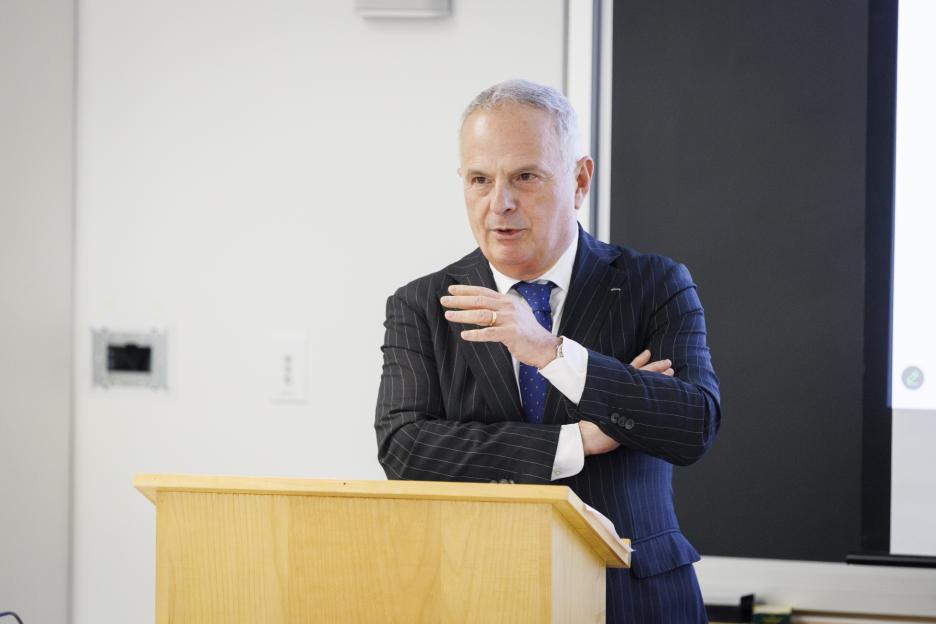
Kenneth Weinstein.
Niles Singer/Harvard Staff Photographer
When it comes to America’s strategic relationship with Japan, Kenneth Weinstein sees challenges, some real and others largely perceived.
In the perceived category, Weinstein, Japan chair at the Hudson Institute, includes the question of whether the U.S. can be relied upon as an ally for Japan and others in the Indo-Pacific. He thinks the answer is an unequivocal yes. He’s skeptical of the idea that the U.S. has lost interest in the region.
The real challenge, he believes, is whether Tokyo and Washington can build a more integrated form of deterrence against China — one that doesn’t limit itself to security concerns.
“It’s about whether the region, at the end of the day, has alternatives to Chinese pressure both militarily but also in the economic realm,” said Weinstein.
Weinstein primarily focused on the economic side of deterrence during a recent seminar through the U.S.-Japan relations program at the Weatherhead Center for International Affairs, detailing the importance of alliances between the U.S., Japan, and the wider Indo-Pacific.
Weinstein spoke mainly in the context of the Free and Open Indo-Pacific (FOIP), a flexible diplomatic strategy put forth by former Japanese Prime Minister Shinzo Abe in 2016.
“It is an institutional expression of creative deterrence,” Weinstein said, “one that promotes connectivity, resilience, security, and prosperity simultaneously.”
That flexibility, he said, is crucial to its effectiveness — especially as a counter to China’s Belt and Road Initiative, which invests in foreign infrastructure and development to boost economic cooperation and ties.
FOIP doesn’t just include allies and direct partners of Japan, but also non-democratic states and countries that don’t formally align with China or Japan and the U.S. Weinstein said that the malleability makes it useful in helping guide U.S. policy through different administrations — from Trump’s first term, through the Biden administration, and into Trump’s second term.
Weinstein praised Japan for boosting its military spending, arguing that it is the biggest U.S. military ally in the region and both a valuable defense exporter and co-developer of equipment with Western allies.
Where Japan has even more value in the region, though, is in economics. Weinstein argued that the Indo-Pacific states deeply value concrete investments, from energy grids to transports to Coast Guard support.
“I think we can bring our heft, our hard-power credibility, whereas Japan can bring development experience,” Weinstein said. “Japan can serve as a bridge, which it has to nations hesitant to stand visibly with the U.S.”
Weinstein said this partnership functioned in the Philippines’ Subic Bay, where Japanese diplomatic efforts at the former U.S. naval base helped open the door for U.S. investments — and edged out Chinese ones.
The wide range of possibilities, Weinstein suggested, partly reflects the personalities of Japanese and American leaders.
Donald Trump, Weinstein said, “is very distrustful of narrow, conventional frameworks .… People think the policy options run from the letter H to the letter L, and he often thinks they run from the letter A to the letter Z.”
This sort of thinking, Weinstein said, leads him to talk about dealing with North Korean threats with “fire and fury,” but also suggesting that the country would make a great place for beachfront condominiums should it denuclearize.
Weinstein said Japan Prime Minister Sanae Takaichi is a “strategic policy expert who does her homework” and who is “creative and independent-minded.”
He said although she differs ideologically from her predecessor Abe in some respects, they both recognized the need for balancing hard power and economic leverage.
In a Q&A session moderated by Christina L. Davis, director of the Program on U.S.-Japan Relations, Weinstein emphasized that the goal of U.S. and Japan policy in the region is not to isolate China, but rather not to allow that nation to build dependence and use that leverage for geostrategic reasons.
But “China absolutely needs to be engaged,” Weinstein said. “I think Shinzo Abe understood this deeply.”
Weinstein also said that he expected neutrality of the Association of Southeast Asian Nations (ASEAN) to continue indefinitely — notwithstanding some sort of military provocation. At this time, he said such a conflict would less likely take place on the island of Taiwan and more likely around Scarborough Shoal, an atoll claimed by the Philippines, China, and Taiwan.