
Your Body Loses Water Even While Breathing
You don't need to be sweating to lose water. Your body continuously loses fluid through breathing, urination and other normal processes, which is why hydration is about replacing losses rather than chasing a universal number.
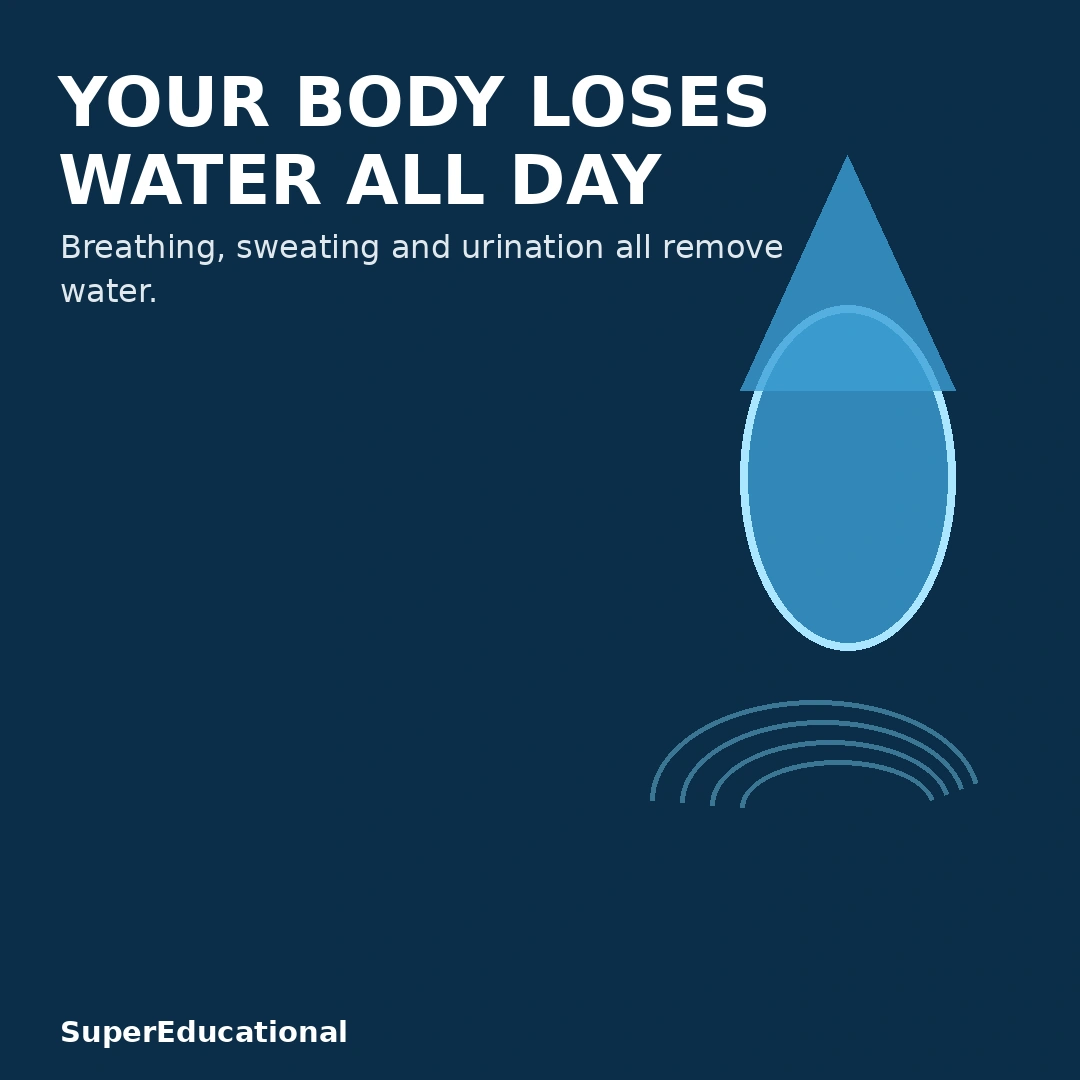
You do not need to be running, exercising, or visibly sweating to lose water.
Your body is losing water all day, every day.
You lose it when you:
- Urinate
- Sweat
- Have a bowel movement
- Breathe
Yes, even breathing contributes to water loss.
The moisture you see in your breath on a cold morning provides a visible reminder of something happening continuously: some water leaves your body with the air you exhale.
That is one reason hydration is an ongoing process rather than something that matters only when you feel extremely thirsty.
Why Does the Body Need So Much Water?
Water is essential for normal body function.
It is found inside and around your cells and contributes to body fluids such as blood, saliva, sweat, tears, and urine. Your body also uses water in processes involving digestion, temperature regulation, waste removal, and maintaining normal fluid balance.
Unlike a storage tank that you fill once and forget about, your body's water supply is constantly changing.
Water comes in through food and drinks.
Water leaves through normal bodily processes.
Hydration involves maintaining an appropriate balance between the two.
You Lose Water Just by Breathing
Every breath involves an exchange between your lungs and the surrounding air.
The air you breathe out contains water vapour.
Individually, each breath represents a tiny amount of water, but you breathe thousands of times every day.
That means respiratory water loss contributes to your total daily fluid loss even when you:
- Are sitting at a desk
- Are sleeping
- Are indoors
- Are not visibly sweating
MedlinePlus notes that the body continuously loses water through breathing, sweating, and urinating.
This helps explain why you still need fluids on quiet days when you have done very little physical activity.
Your Hydration Needs Change
There is no reason to expect your body to lose exactly the same amount of fluid every day.
Consider two different days.
Day 1
You spend most of the day indoors in comfortable temperatures and do very little exercise.
Day 2
You spend several hours outside in hot weather and exercise intensely.
Your fluid losses are unlikely to be identical.
The same applies during illness.
Vomiting, diarrhoea, fever, and heavy sweating can increase fluid loss and raise the risk of dehydration.
Fluid requirements can also vary according to factors such as:
- Age
- Body size
- Activity level
- Climate
- Pregnancy or breastfeeding
- Health conditions
- Medications
There is therefore no single daily number that perfectly describes everyone's needs in every situation.
What About “Eight Glasses of Water a Day”?
You have probably heard the advice:
“Drink eight glasses of water every day.”
It is simple and memorable.
But it is not a universal biological requirement.
Some people may need more.
Others may need less.
Mayo Clinic notes that fluid requirements differ according to factors including health, age, activity, environment, and weather. It also points out that total water intake includes water from food and other beverages, not just glasses of plain water.
That distinction matters.
Soup contains water.
Fruit and vegetables contain water.
Milk contains water.
Tea and coffee also contribute fluid.
So hydration is broader than counting bottles of plain water.
General Guidelines Are Not Personal Prescriptions
For context, commonly cited guidance for healthy adults corresponds to roughly 2.7 litres of total fluid per day for women and 3.7 litres for men, including water obtained from beverages and food.
But these are population-level reference values, not personalised requirements for every individual.
Think of them as general context rather than a precise drinking prescription.
Your actual needs may differ substantially.
Thirst Is Useful — But Not Perfect
Thirst is one of the body's mechanisms for signalling a need for fluid.
If you feel thirsty, drinking is generally an obvious response.
But thirst should not always be treated as a perfect measuring instrument.
Older adults, for example, may have a reduced sense of thirst and can therefore be at greater risk of dehydration.
People who are ill, very active, or exposed to high temperatures may also need to pay more deliberate attention to fluid replacement.
Your Urine Can Offer a Clue
Urine colour can sometimes provide a rough indication of hydration.
For many healthy people, pale yellow urine is consistent with adequate hydration, while darker urine can be one possible sign that more fluid may be needed.
But it is only a rough indicator.
Foods, medicines, supplements, and medical conditions can also affect urine colour.
So it should not be treated as a perfect hydration test.
Exercise Increases Fluid Loss
Physical activity often increases sweating.
And the more fluid you lose through sweat, the more you generally need to replace.
This becomes particularly important during:
- Long workouts
- Outdoor sports
- Physically demanding jobs
- Hot-weather exercise
Mayo Clinic advises replacing the additional water lost through activities that make you sweat.
For prolonged or intense exercise, particularly in heat, hydration can also involve replacing electrolytes rather than simply consuming unlimited amounts of plain water.
Hot Weather Changes the Equation
When your body becomes hot, sweating helps regulate temperature.
That cooling mechanism costs water.
So a person who spends several hours outside during hot or humid weather may lose considerably more fluid than someone sitting indoors.
The NHS specifically advises drinking more when there is an increased risk of dehydration, including during hot weather or when sweating from exercise.
This is why hydration deserves extra attention during heatwaves.
Illness Can Increase Fluid Loss Quickly
Vomiting and diarrhoea can cause significant losses of both water and electrolytes.
Fever can also increase the risk of dehydration.
In these circumstances, fluid replacement may need to be more deliberate than simply drinking according to your normal routine.
For significant vomiting or diarrhoea, oral rehydration solutions may sometimes be recommended because they replace water along with salts and other substances that have been lost.
Severe dehydration can be a medical emergency.
Signs You May Be Dehydrated
Possible signs of dehydration include:
- Thirst
- Dry mouth
- Dark yellow urine
- Urinating less frequently
- Tiredness
- Dizziness or light-headedness
More serious dehydration can produce more severe symptoms and requires medical attention.
Babies, young children, and older adults can be particularly vulnerable.
More Water Is Not Always Better
There is another misconception worth correcting:
If some water is good, more is not automatically better.
Drinking excessive amounts of water can overwhelm the body's ability to remove it and, in rare cases, dangerously lower the concentration of sodium in the blood—a condition known as hyponatraemia.
Hydration is about balance.
Not dehydration.
Not overhydration.
Some People Are Told to Restrict Fluids
Generic advice to “drink more water” can also be inappropriate for some medical conditions.
People with advanced chronic kidney disease or kidney failure, for example, may need to limit fluid intake because their bodies may not remove excess water effectively.
Some people with heart failure may also be advised by their healthcare team to monitor or limit fluid intake.
That is why someone who has been given a specific fluid recommendation by a healthcare professional should follow that individual guidance rather than a general hydration rule found online.
Think Replacement, Not Obsession
For most healthy people, hydration does not need to become a complicated mathematical exercise.
A more useful idea is:
Your body continually loses water, so regularly replace what it loses.
Then pay additional attention when circumstances increase those losses.
For example:
Normal day → maintain regular fluid intake
Hot weather → account for additional sweating
Exercise → replace exercise-related losses
Vomiting or diarrhoea → pay closer attention to fluids and electrolytes
Medical condition → follow personalised healthcare guidance
This approach focuses on maintaining balance rather than achieving an arbitrary number of glasses.
Why It Matters
Your body is continuously exchanging water with its environment.
Some losses are obvious, such as sweat after exercise.
Others are easy to overlook, including the water leaving your body every time you exhale.
Adequate hydration supports normal body function, but individual fluid requirements vary considerably.
The practical lesson is simple:
Drink regularly, replace additional losses when they occur, and recognise that hydration is about balance—not drinking as much water as possible.


Continue reading

How to fix U.S. healthcare? ‘Radical action,’ says John McDonough.
How to fix U.S. healthcare? ‘Radical action,’ says John McDonough. Chan School expert links soaring costs to broader policy shifts in ‘America’s Wrong Turn’...
Why Is U.S. Healthcare So Expensive? John McDonough Says the Answer Goes Back Decades
Why does the United States spend so much more on healthcare than other wealthy countries? Harvard professor John McDonough traces part of the answer to decades of policy change, consolidation and growing commercial influence.
Screening newborns for cancer risk
Screening newborns for cancer risk Blood samples routinely collected at birth could be used for genetic testing, potentially helping 1,000 children a year, st...

For women in menopause, ‘not all healthy diets are equal’
Tong Xia.Niles Singer/Harvard Staff Photographer For women in menopause, ‘not all healthy diets are equal’ Study comparing 11 eating patterns finds two clea...