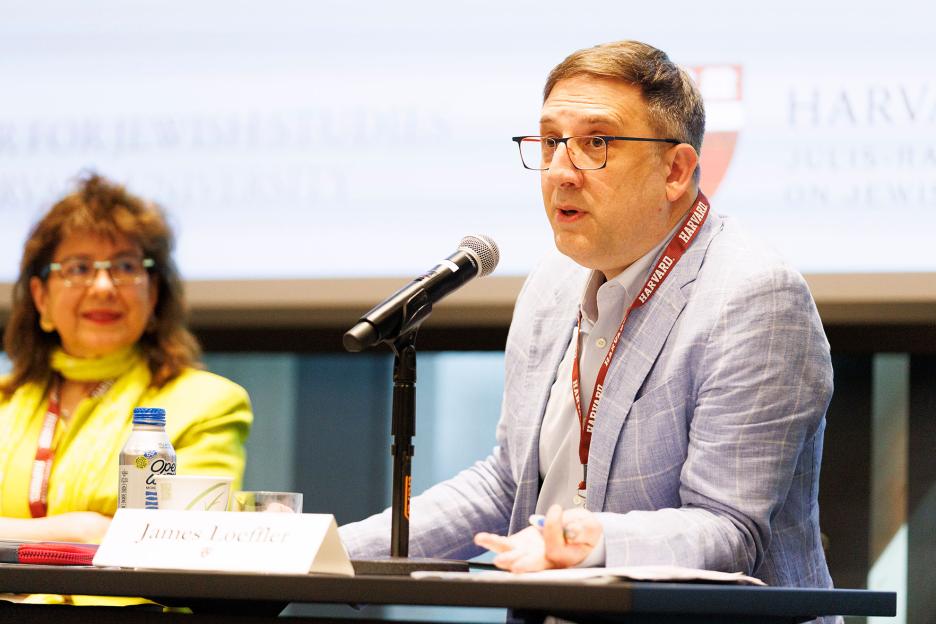
James Loeffler.
Veasey Conway/Harvard Staff Photographer
Confronting campus antisemitism
Schools have made progress in calling it out but need to develop a more forceful response, scholars say
Alvin Powell
Harvard Staff Writer
Scholars explored antisemitism through history and its intersection with universities in a wide-ranging conference May 14 at Harvard’s Enterprise Research Center.
Universities reflect movements and biases in broader society, speakers noted — a reality that helps explain antisemitism on campus but doesn’t provide a clear roadmap for countering it. Even so, they said, it’s important that higher ed leaders confront the issue in the strongest terms. The symposium was seen as a key step along those lines.
“Academic conferences don’t solve things ordinarily: That’s not their function.” said Noah Feldman , Harvard’s Arthur Kingsley Porter University Professor, who introduced the event. “The function of an academic conference is to explore, study, and seek to get a better understanding. Our objective — always in this University — should be to pursue the truth and to do that in an open-minded way that welcomes all different points of view and perspectives.”
“Antisemitism and Universities” drew scholars from Harvard, Dartmouth College, the University of California at Berkeley, Johns Hopkins University, and Ben-Gurion University of the Negev. It was sponsored by the Center for Jewish Studies , Harvard Law School , and the Office of the President and Provost .
The conference included discussions about Jews and antisemitism in the arts, in U.S. academia, in tension with the Christian roots of many universities, and as a factor in conversations about the importance of place.
James Loeffler , the Felix Posen Professor in Modern Jewish History at Johns Hopkins, described a history of “occlusion” and “extrusion” for Jews at universities. Extrusion occurs when Jews are visible but altered in some way. Occlusion occurs, he said, when Jewish scholars are blocked or hidden from view. He recalled the “Unite the Right” rally in Charlottesville in 2017, which took place while he was on the faculty at the nearby University of Virginia. Though protesters were shouting “Jews will not replace us!” the statements that followed by more than 20 university presidents decried racism, homophobia, and misogyny, but didn’t mention antisemitism, Loeffler said.
“What was shocking to me was the silence afterwards about antisemitism and its place in what was happening,” Loeffler said. “The university community simply did not know how to speak about antisemitism. It was very accustomed to speaking about racism and grappling with that, but understanding this kind of hatred — which should have, in one sense, been easy to talk about — was challenging.”
Feldman said that strong currents of antisemitism at Harvard mostly waned in the second half of the 20th century. His parents, who met on campus in the 1960s, found a community welcoming to Jewish students, he said, adding that his own experience has tracked with theirs.
“I myself was raised with two stories about Harvard, both of which I believe to be true — that Harvard has a history in which antisemitism played a meaningful role, and that antisemitism didn’t go away overnight but slowly and gradually was shifted, changed, and eroded by the University’s institutional shifts and changes,” he said. “Harvard has been, though the second half of the 20th century, a place of increasing prominence, possibility, and openness to Jews, and that frames my own experiences here very much. For that reason, it’s been especially challenging psychologically, emotionally, and sometimes even intellectually to come to terms with changing circumstances in the world and on campus and their effect on Jewish experiences here.”
Eric Nelson , the Robert M. Beren Professor of Government at Harvard, said that his own life may provide an illustration of the tension between the experience of antisemitism and the sometimes-tepid response to it by non-Jews.
Nelson recalled growing up privileged in New York and his education at prestigious schools. He came to Harvard College as an undergraduate and stayed, joining the faculty. He described himself as “one of the least oppressed people I know,” and yet: “My mother was born in a displaced persons camp in Germany, and most of my family died in the Holocaust.”
He added: “One can look around and see Jews as overrepresented, as coming from fancy schools, and as anything but an oppressed minority. First of all, some have had very difficult lives, although I didn’t, and those that didn’t nonetheless are close to a history of immense pain.”
In response to audience questions, Susannah Heschel , the Eli M. Black Distinguished Professor of Jewish Studies at Dartmouth, said that scholars of antisemitism and organizations that deal with antisemitism spend a lot of time defining and labeling it, but are silent on what a response should be.
“I don’t need a report card, I need to know what to do, and that’s a big failure,” Heschel said.
Whatever is done should address what Heschel sees as a lack of hope among her students.
“What can we do to give them hope? And, in Jewish Studies, we have to ask ourselves, ‘What’s the message, what’s the takeaway?’” Heschel said. “They take Jewish history, they memorize everything, but what can I give them that will live inside of them in the future? That’s what we have to figure out.”