Diversification Reduces Risk — It Doesn't Remove It
“Don’t put all your eggs in one basket” is more than an old proverb.
In investing, it describes one of the most important principles of risk management:
diversification.
If your entire portfolio depends on one company, one industry, or one type of investment, a serious setback in that area can affect a large proportion of your money.
Diversification spreads your exposure across different investments so that your financial outcome is not entirely dependent on a single holding.
But there is an important misconception to correct:
Diversification does not make investing risk-free.
What Is Diversification?
Diversification means spreading money among a variety of investments rather than concentrating everything in one place.
The basic idea is simple.
Imagine putting your entire investment into the shares of one company.
Your result would depend heavily on what happens to that business.
A product failure, management problem, regulatory change, loss of customers, or industry downturn could have a major effect on your portfolio.
Now imagine that your investments are spread across different companies, industries, and potentially different asset classes.
One poor-performing investment may still hurt your portfolio, but its effect may be less severe because your entire financial outcome does not depend on it.
Investor.gov describes diversification as investing in a variety of assets to lower the overall risk of an investment portfolio.
Diversification Helps Manage Concentration Risk
One of diversification's main benefits is reducing concentration risk.
Concentration risk occurs when too much of your portfolio depends on a particular investment or closely related group of investments.
For example, a portfolio heavily concentrated in:
- One company
- One industry
- One geographic market
- One type of asset
may be particularly vulnerable if that area experiences a significant decline.
Diversification attempts to reduce this dependence by spreading exposure.
The goal is not to ensure that every investment rises.
It is to avoid allowing one investment decision to determine the fate of the entire portfolio.
Owning More Investments Doesn't Automatically Mean You're Diversified
There is another important distinction.
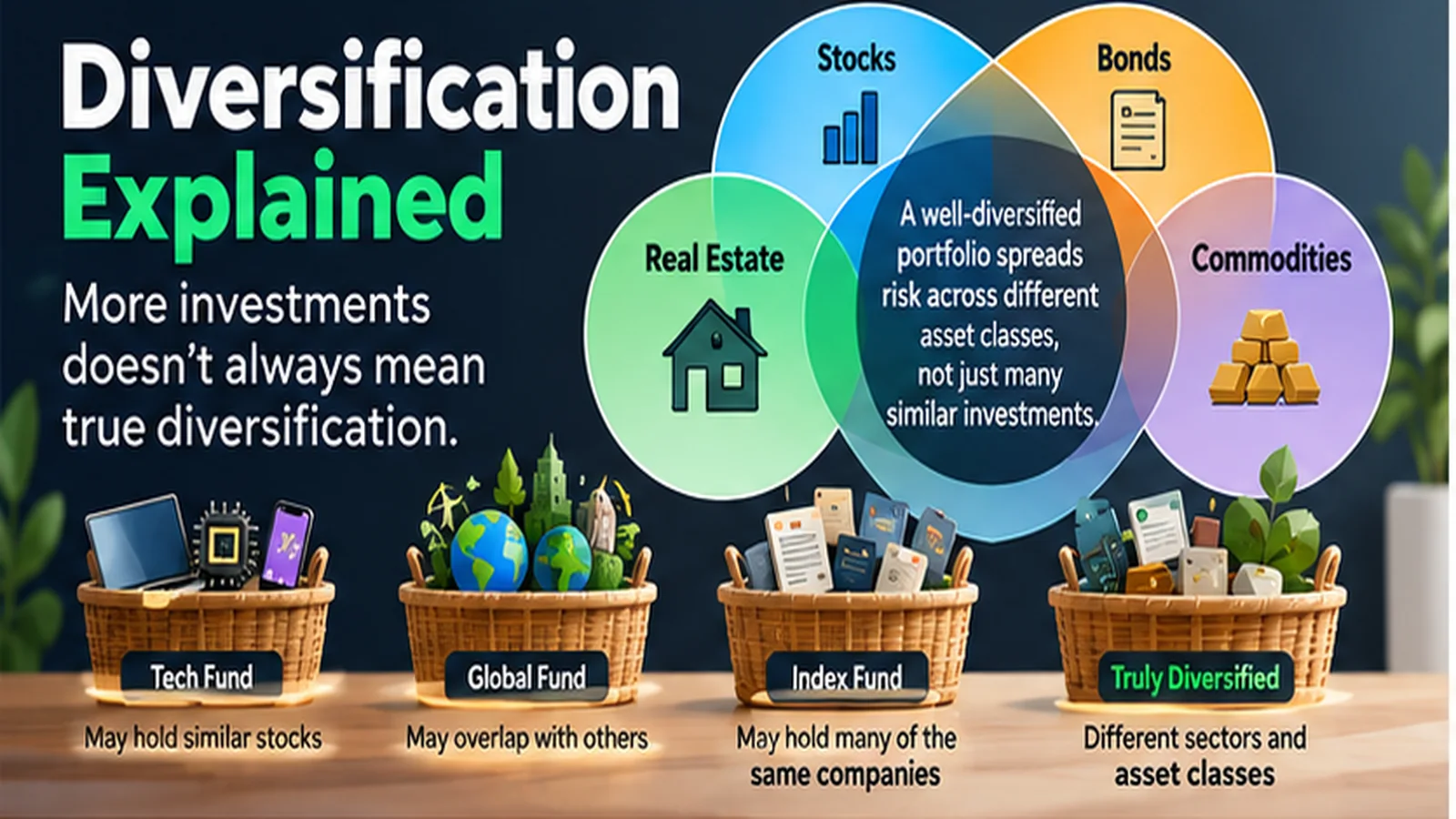
Simply owning many investments does not necessarily create meaningful diversification.
Imagine owning shares in 20 companies that all operate in the same industry.
You have more individual holdings, but many of them may respond similarly to the same economic or industry-specific events.
A diversified portfolio may therefore spread investments at different levels, including between asset categories and within those categories. Investor.gov specifically discusses diversification across areas such as stocks, bonds, and cash equivalents, as well as diversification within individual asset classes.
The important question is not simply:
“How many investments do I own?”
It is also:
“How dependent are these investments on the same risks?”
Diversification Is Not the Same as Asset Allocation
The terms are related, but they are not identical.
Asset allocation refers to how you divide your portfolio among different types of investments, such as stocks, bonds, and cash.
Diversification refers more broadly to spreading investment exposure so that the portfolio is not excessively dependent on a small number of holdings or risks.
For example, someone could allocate 100% of a portfolio to stocks and still diversify among many companies and industries.
Another investor might spread money between stocks, bonds, and cash while also diversifying within each category.
Investor.gov notes that both asset allocation and diversification are important approaches to managing investment risk.
Diversification Cannot Stop a Broad Market Decline
This is where one of the biggest misconceptions appears.
Diversification can reduce some types of risk, but it cannot eliminate every type.
If financial markets fall broadly, many investments may decline at the same time.
Investor.gov explicitly warns that diversification cannot guarantee that investments will avoid losses when the market drops.
That means a diversified portfolio can still:
- Lose value
- Experience volatility
- Decline during recessions
- Be affected by interest-rate changes
- Be affected by inflation
- Respond to geopolitical or economic shocks
Diversification is therefore a risk-management strategy, not an insurance policy against loss.
All Investing Involves Risk
There is no investment portfolio that can guarantee both meaningful returns and complete protection from loss.
Investor.gov states that all investments involve some degree of risk.
Different investments simply expose investors to different types and levels of risk.
That is also why promises of unusually high returns with little or no risk should be treated cautiously.
Greater potential returns generally come with greater uncertainty.
Your Appropriate Mix Is Personal
There is no single diversified portfolio that is automatically right for everyone.
The appropriate mix depends on factors including:
Your goals
Are you investing for retirement decades from now, a home purchase, education costs, or another objective?
Your time horizon
Someone who may need their money soon has different considerations from someone investing for several decades.
Your ability and willingness to tolerate losses
Some investors are comfortable with large fluctuations in exchange for greater potential long-term returns.
Others prefer less volatility even if that means accepting lower potential returns.
Investor.gov identifies time horizon and risk tolerance as important considerations when determining asset allocation.
Diversification May Change Over Time
An investment mix that makes sense today may not remain appropriate forever.
Your circumstances can change.
You may:
- Get closer to retirement
- Reach an important financial goal
- Need access to money sooner
- Experience changes in income
- Become more or less comfortable with investment risk
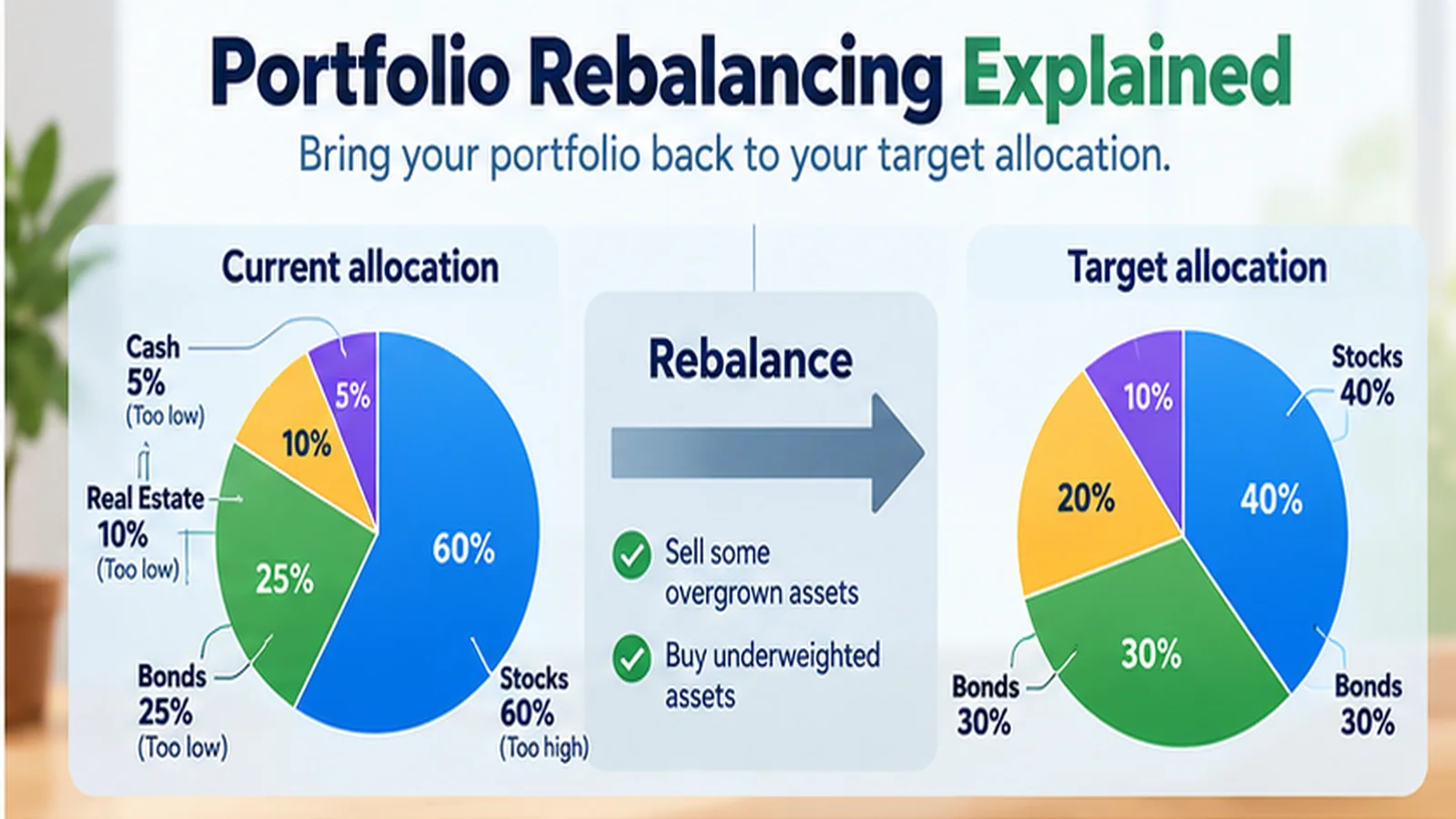
Portfolio values can also move enough that one asset category becomes a much larger proportion of the portfolio than originally intended.
This is why investors sometimes review and rebalance their portfolios to bring the mix back toward their intended allocation. Investor.gov includes rebalancing alongside asset allocation and diversification as part of long-term portfolio management.
What Diversification Can — and Cannot — Do
A useful way to remember the principle is:
Diversification can reduce dependence on one investment.
It cannot guarantee that your investments will increase in value.
It may help reduce the damage caused by a particular company or sector performing badly.
It cannot prevent losses when broader markets fall.
It can help manage risk.
It cannot remove risk.
Why It Matters
Diversification is primarily a risk-management principle, not a promise of investment success.
The goal is not to find a portfolio in which nothing ever loses money.
The goal is to avoid allowing one company, industry, asset class, or other concentrated exposure to determine too much of your financial outcome.
So remember the familiar advice:
Don't put all your eggs in one basket.
Just don't mistake having several baskets for a guarantee that none of them can fall.